
Last updated September 20, 2026
Full 25-point door and opener safety check with every visit - springs, cables, rollers, tracks, and your LiftMaster or Chamberlain opener included
You get a price before we start. It does not change when the truck arrives.
 Before
 After
After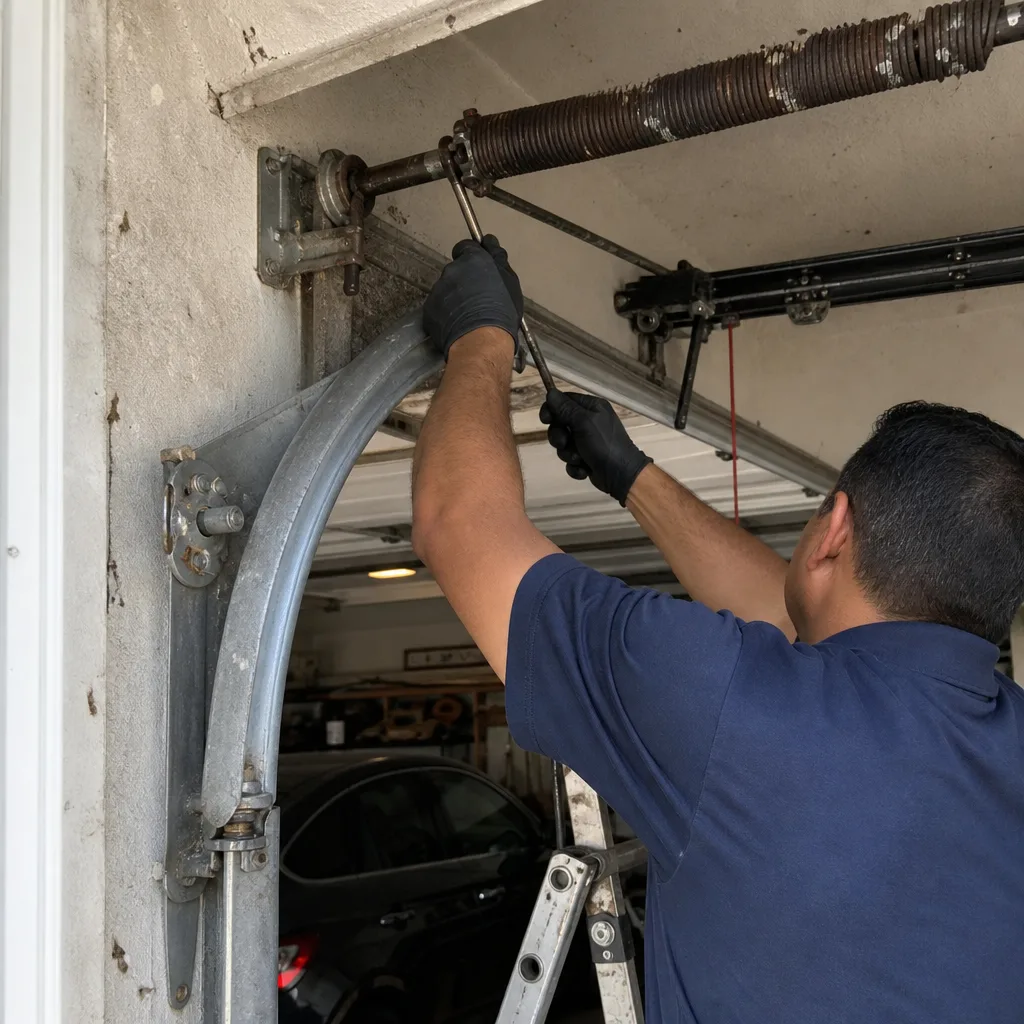 Before
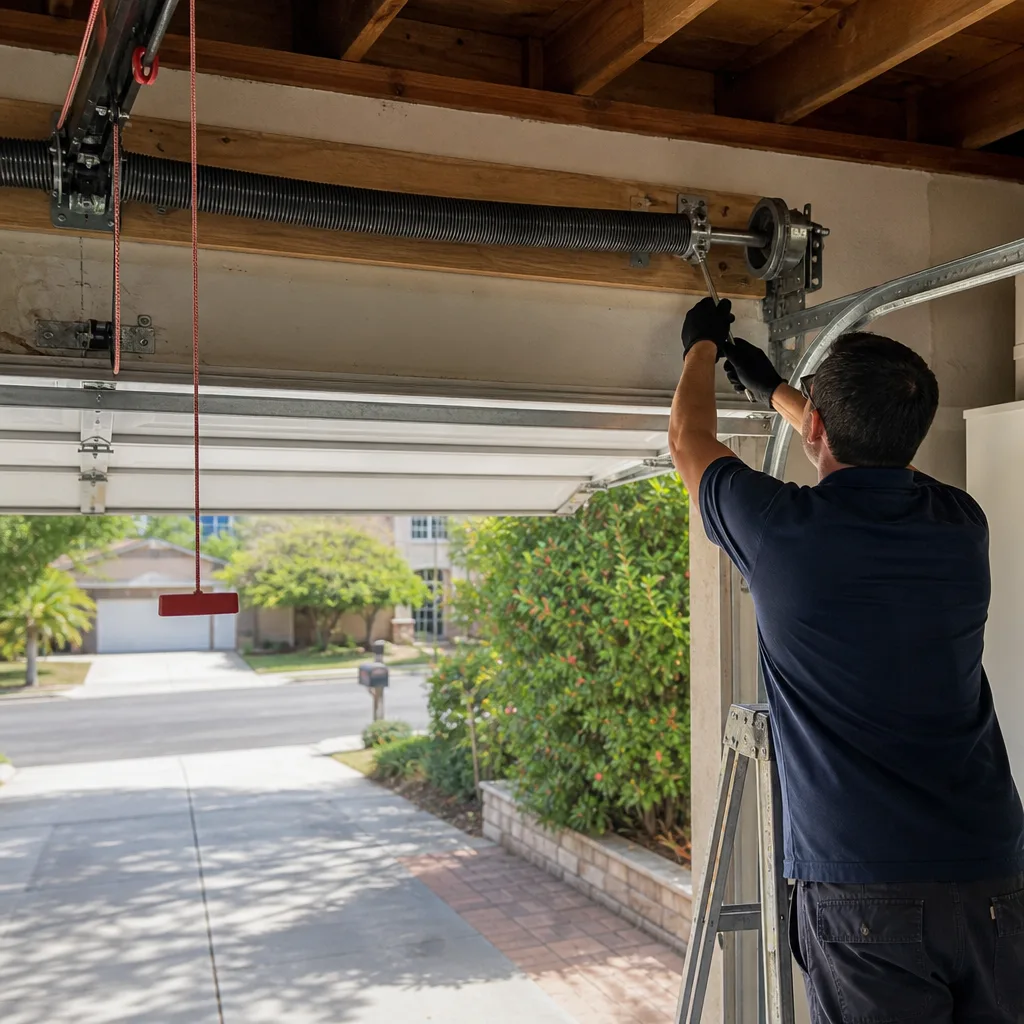 After
After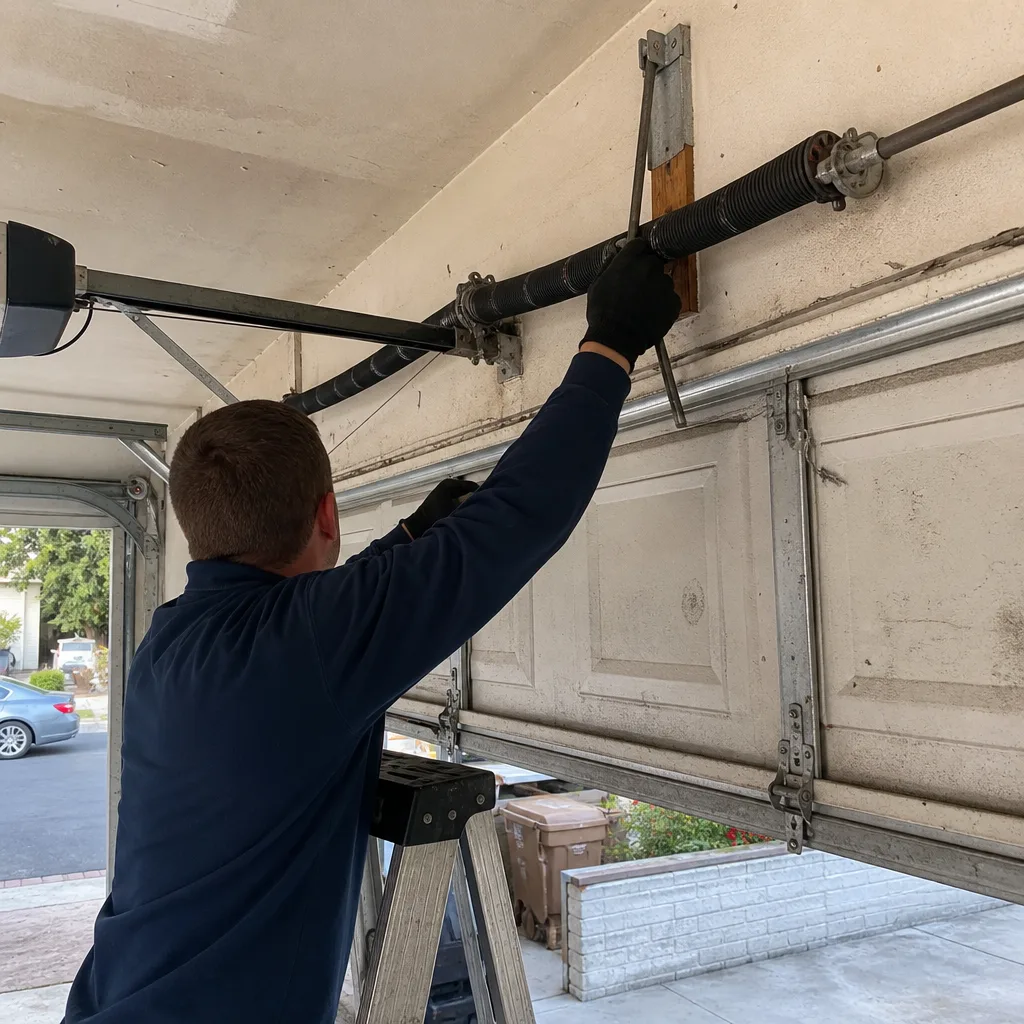 Before
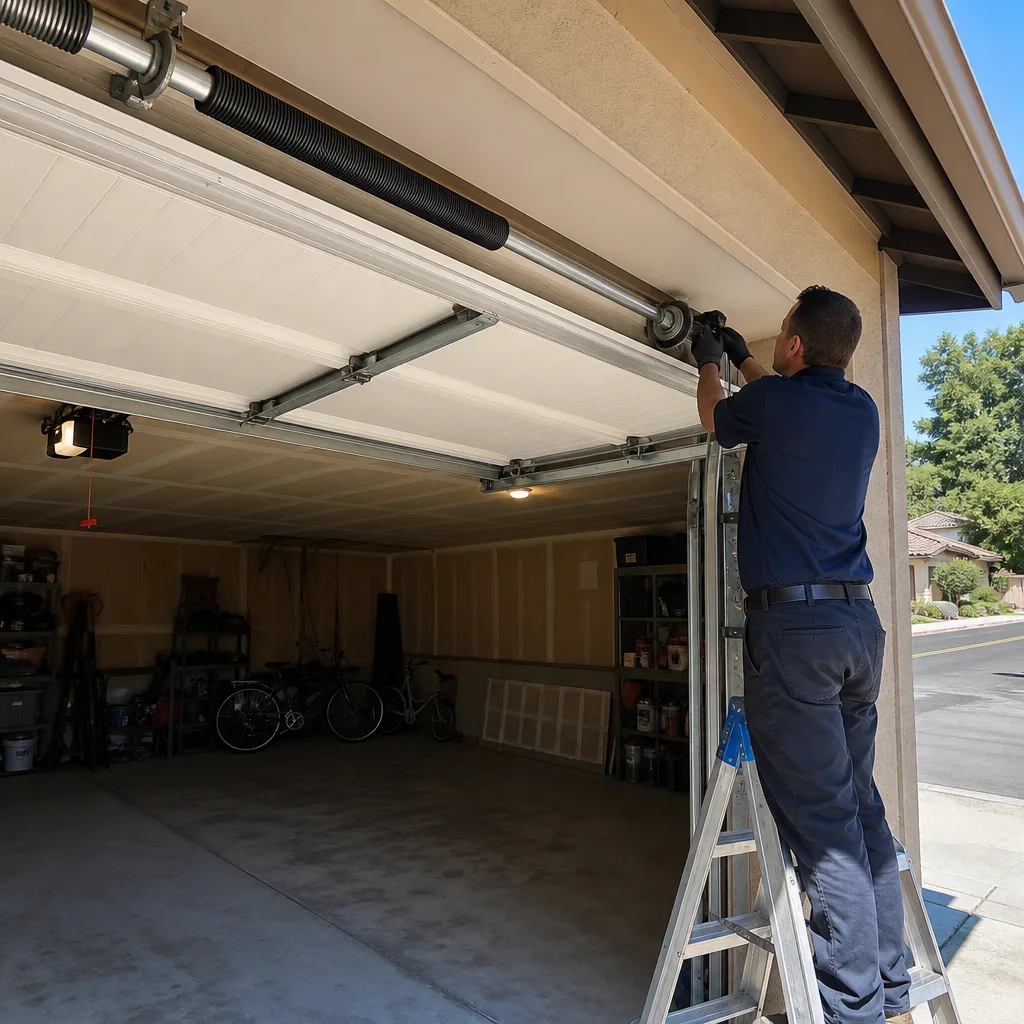 After
AfterGarage Door Warning Signs: A Thousand Oaks Homeowner’s Reference Guide
Here’s a counterintuitive fact: by the time most Thousand Oaks homeowners notice a garage door problem, the underlying cause has usually been developing for four to seven months. The door didn’t fail that morning. It had been signaling, in small mechanical ways, since spring. What sounds like a squeak is sometimes a roller bearing eating itself. What looks like a slight lag on open is sometimes a torsion spring losing tension coil by coil, week by week. This guide is a field manual for reading those signals before they become a service call at midnight or, worse, a door that won’t open when you’re already late. We’ll walk through what each sound means, which visual cues matter and which don’t, when to watch, when to schedule, and when to leave the door alone and call someone. If you live in Thousand Oaks, where summer heat and canyon dust work on garage hardware year-round, this is written for your door, your climate, and your schedule.
Quick Answer
The garage door warning signs that matter in Thousand Oaks fall into three tiers: Stop signs (broken spring, frayed cables, a door that reverses mid-close without a visible obstruction), Schedule signs (grinding, rattling, visible roller wobble, uneven closing gaps), and Monitor signs (mild squeaking, slight door flex, slow response from an older opener). A door that reverses on close is the most commonly misdiagnosed warning sign; it is rarely the sensor eyes and usually the auto-reverse force threshold reacting to mechanical resistance from worn rollers, failing springs, or track misalignment. If the door makes a sound like a muffled gunshot and the spring looks split, stop using it immediately and call a professional.
Table of Contents
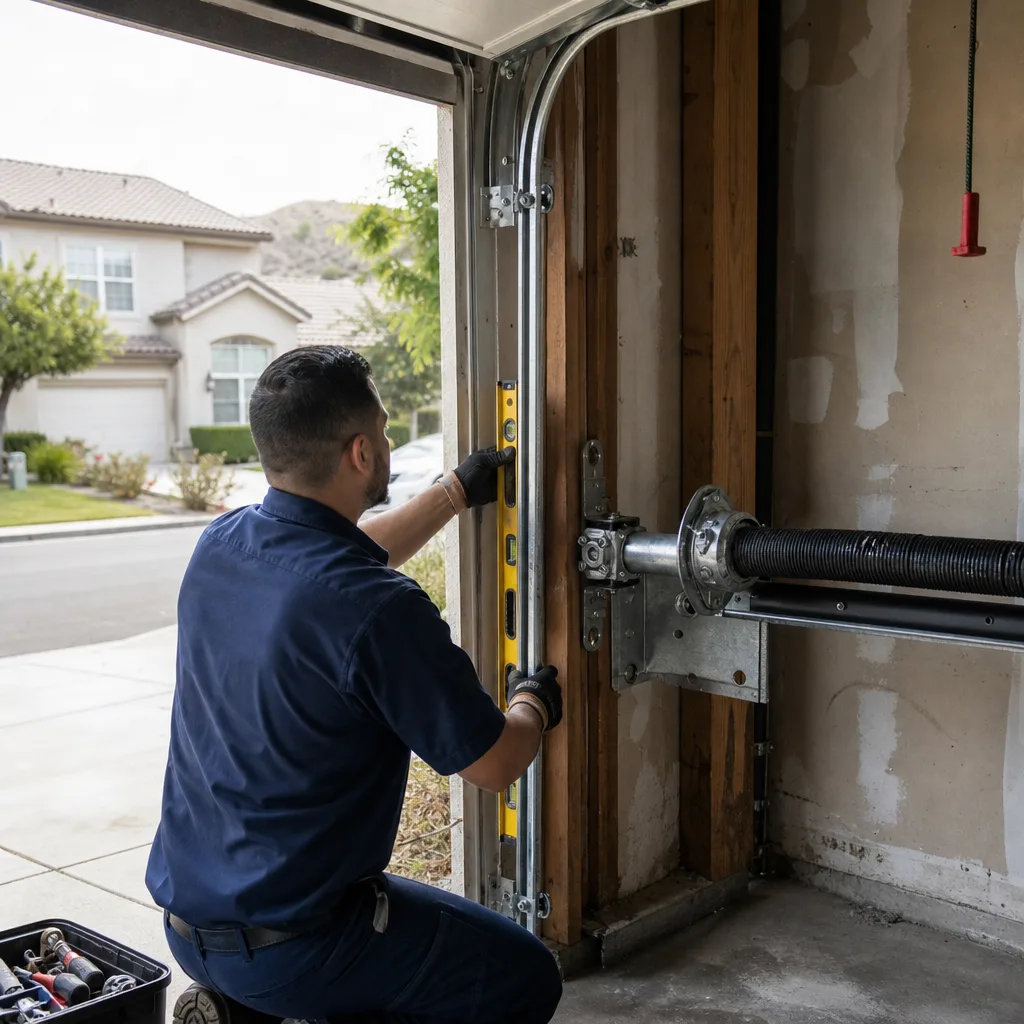
- The Three-Tier Triage: Stop, Schedule, Monitor
- The Noise Taxonomy: What Grinding, Squeaking, Popping, and Rattling Actually Mean
- Visual Indicators You Can Measure: Cable Twist, Spring Gaps, Roller Wobble
- The Slow Door Problem: Why Open vs. Close vs. Both Changes the Diagnosis
- The Reversing Door: Why Cleaning the Sensors Usually Wastes Your Morning
- Thousand Oaks-Specific Factors: Heat, Dust, and Canyon Air
- How to Describe a Warning Sign to a Contractor Without Wasting a Service Call
- Common Mistakes to Avoid
- When to Call a Professional
- Frequently Asked Questions
- The Bottom Line
BeforeAfterThe Three-Tier Triage: Stop, Schedule, Monitor
Not every garage door symptom is an emergency. Treating them all as emergencies leads to unnecessary service fees. Treating none of them as emergencies leads to a door that fails at the worst possible moment. Here’s the system we use to sort warning signs, and the one we recommend to every Thousand Oaks homeowner who asks what they should actually worry about. If you’re planning a larger project, see our guide on How to Hire a Garage Door Contractor in Thousand Oaks: A Step-by-Step Guide.
Tier One: Stop Using the Door Now
These are the signs that indicate a genuine safety risk. Do not operate the door, even once more, if you observe any of these. A torsion spring under tension carries enough stored energy to cause serious injury if it releases unexpectedly. A frayed lift cable under load can snap and whip. These are not items to monitor.
- The spring is visibly broken or split. Torsion springs sit above the door on a horizontal shaft. If you see a gap in the coil, a clean break at the midpoint, or a spring hanging loose, the door’s entire lifting mechanism is compromised.
- Lift cables are frayed, rusted through, or have visible broken strands. Cables run along both sides of the door and connect to the bottom brackets. If the strands look like a whisk broom, the cable is failing.
- The door reverses immediately after hitting the floor or reverses mid-close with no visible obstruction. This is the auto-reverse force threshold engaging because something in the drive system is binding. It is not normal behavior.
- The door jerks to one side when opening or closing. This indicates uneven tension, a failing spring on one side, or a cable that has slipped off its drum. Operating the door in this condition risks pulling the door out of its track.
- You hear a loud bang from the garage and the door now refuses to open. That bang was almost certainly a torsion spring breaking. Do not try to force the door open manually. Do not pull the emergency release. Call for service.
Tier Two: Schedule Service Within 30 Days
These are functional degradations. The door still works, but components are wearing at an accelerated rate. Addressing them within a month prevents a Tier One event and usually costs less than the repair that follows if ignored.
- Grinding or metal-on-metal sound during operation. Roller bearings are failing. The rollers are still rolling, but they’re chewing themselves up.
- Visible roller wobble. If you can move a roller side to side with a finger, the bearing has play. Normal rollers have no lateral movement.
- The door pauses or hesitates at a specific point in its travel. This usually indicates a track section that’s slightly pinched, a roller that’s binding, or a section hinge that’s worn.
- Uneven gap at the bottom when closed. One side seals against the concrete, the other lets in daylight. This can mean a spring is losing tension, a cable has stretched, or the door has shifted on its track.
- Squeaking that’s getting progressively louder over months. One mild squeak is maintenance. A squeak that you notice every single time and that’s louder than it was in March is a bearing or hinge pin wearing toward failure.
Tier Three: Monitor and Recheck in 90 Days
These are conditions that are worth noting but don’t require action today. Photograph them. Write down the date. Check again in three months. If anything has changed, move the item up a tier.
- Mild squeak that appears only in cold or damp weather. Metal contracts. Lubrication gets stiff. This can be entirely seasonal. If it’s humid in your Thousand Oaks garage and the squeak appears, that’s a different signal than a constant squeak in dry heat.
- Slight door flex when opening. Some flex in a steel door is normal, especially a double-wide door. The question is whether the flex is new or has always been there.
- Opener response is slightly slower than it used to be. If the door opens fully but takes a beat longer than it did when you moved in, this could be normal capacitor aging in an older opener. Note it. Time it. Check again in 90 days.
- Light surface rust on springs or hardware. This is worth noting, and worth cleaning and lubricating at your next door service. It is not urgent.
What this triage system does is remove the emotion from the decision. A garage door warning sign in Thousand Oaks is a data point, not a crisis, unless it falls into Tier One. For a full overview of local door systems, see The Complete Guide to Garage Door in Thousand Oaks. Most warning signs fall into Tier Two: the door still works, but you have a window of time to address the cause before the symptom becomes an emergency. Our technicians spend a lot of time on doors that homeowners monitored for too long, and a small number on doors that homeowners stopped using at the first squeak. Both are avoidable.
The Noise Taxonomy: What Grinding, Squeaking, Popping, and Rattling Actually Mean
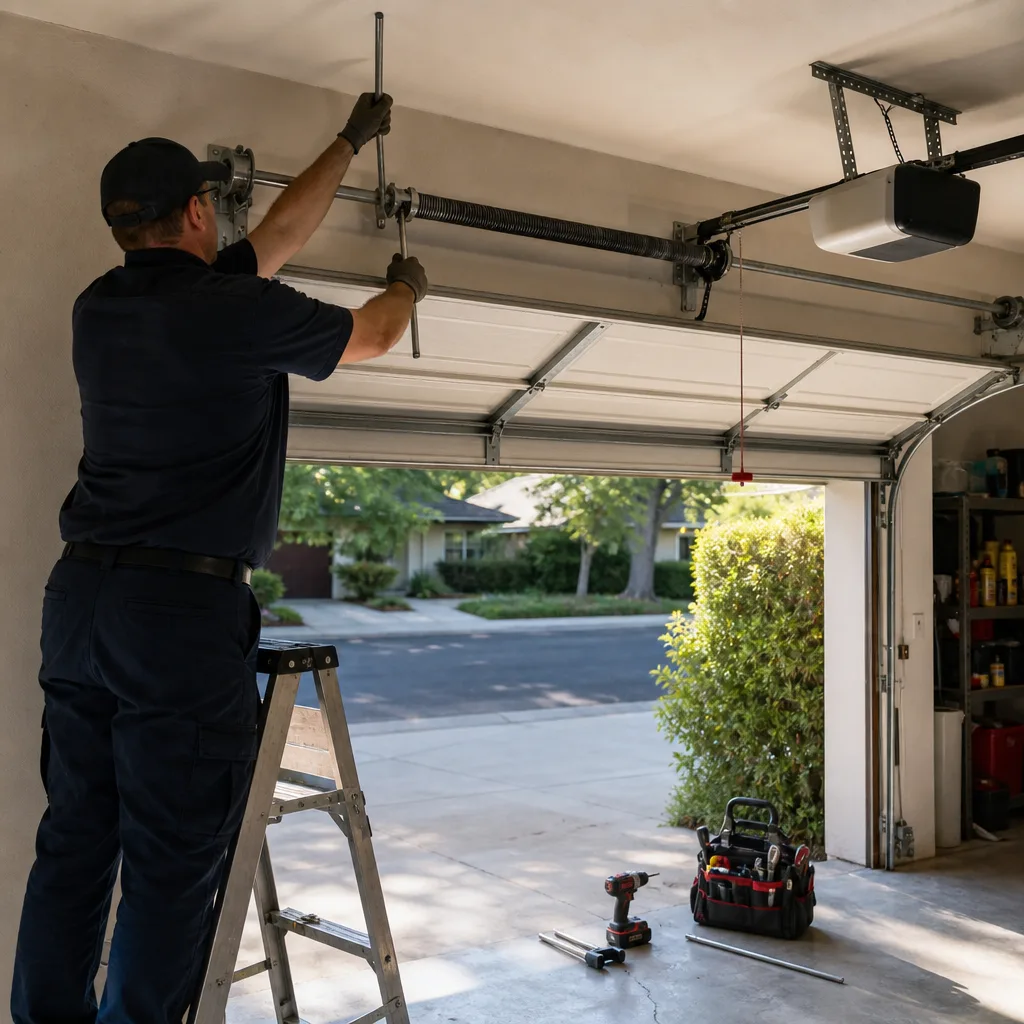
Garage doors make four distinct noises, and each one implicates a different part of the system. The problem with most online advice is that it lumps all of these into “weird noises” and then offers the same generic fix. That’s like saying a car problem is “the engine” without distinguishing a rod knock from a belt squeal. Both are under the hood. Only one is urgent. Here’s the taxonomy we use at Servo Garage Doors Thousand Oaks home to diagnose sound before we ever see the door.
Grinding: Metal on Metal Without Lubrication
Grinding is the sound of a roller bearing that has lost its internal lubrication and is now running metal against metal inside the roller itself. The roller wheel may still turn, but it’s doing so with friction. Grinding is almost always a roller problem, not a spring problem, and it frequently comes with visible metallic dust on the track below the affected roller. It gets worse when the door is under load, which means you’ll hear it most clearly at the bottom two panels. Grinding is a Schedule item: the roller hasn’t failed yet, but the bearing is done. In our experience in Thousand Oaks, doors that grind for more than 60 days tend to flat-spot the roller and then the roller starts dragging instead of rolling, which then puts lateral force on the track. That’s when a $12 roller replacement becomes a track repair.
Squeaking: Two Surfaces Rubbing Without a Bearing Between Them
Squeaking is not roller-bearing failure. It’s two pieces of metal or metal against nylon rubbing where they meet. The most common sources are the section hinges between panels, the torsion spring coils themselves (as they wind and unwind), and the door edge rubbing against a weather seal that’s lost its flexibility. A squeak on every cycle, year-round, is a lubrication issue or a hinge pin starting to wear. A squeak that only appears when it’s damp or cold is metal contracting and is often seasonal. The diagnostic test is simple: apply white lithium grease to the hinge pins and spring coils. If the squeak disappears, it was lubrication. If it returns within three weeks, the hinge is wearing and should be scheduled for replacement. Do not use WD-40 on a garage door. It’s a solvent, it strips the existing lubrication, and it makes the squeak worse within a month.
Popping: The Sound of a Spring Under Stress
A popping sound during door operation is the sound of a torsion spring coil releasing tension momentarily. It’s most common in doors with two springs of unequal age or tension, or in a single spring that’s nearing the end of its service life. The spring doesn’t wind and unwind smoothly; instead, it “slips” a small amount on each cycle, and that slip is the pop. Popping is a Schedule item, but it’s the highest-priority schedule item on this list. A spring that’s popping is demonstrating that it’s no longer holding stable tension. In a worst-case scenario, that instability is a precursor to a full spring break. If the pop is accompanied by any visible gap forming between coils, move it to Stop immediately. A torsion spring that breaks while the door is mid-cycle releases its stored energy all at once. The door drops. People have been injured. Do not operate a popping door with a visible coil gap.
Rattling: Loose Fasteners, Loose Hardware, or Worn Hinges
Rattling is the most benign noise on this list, but it has the widest range of causes. A rattle means something is loose. That can be as simple as a hinge bolt that worked its way out over a decade of cycles, or as involved as a track bracket that’s lost its anchor to the wall. The diagnostic step is to observe the door while it runs and isolate the rattle to a panel, a corner, or the track. Most rattles in Thousand Oaks doors are hinge-related: the nylon bushing inside a hinge wears out, and the door panels develop play at the seam. On a single-car door, that’s annoying. On a double-car door in a wind-exposed area like Newbury Park or the Conejo Grade side of town, that panel play can become a wind-rattle issue that wears out the remaining hinge bushings in a cascade. Rattling is a Schedule item if it’s consistent, and a Monitor item if it only appears when the door is actively in motion and it’s been consistent for years.
One of the most useful things you can do before calling a contractor is record the sound on your phone. Fifteen seconds of video, close to the door, while it opens and closes. A technician who hears the actual grind, squeak, pop, or rattle can identify the likely component before they arrive, which means the correct parts go on the truck. Sound is diagnostic data. Use it that way.
Visual Indicators You Can Measure: Cable Twist, Spring Gaps, Roller Wobble
Some of the most important warning signs on a garage door are not audible. They’re visible, but they require you to look at specific components in specific ways. These are the indicators that are hard to photograph but easy to measure once you know what you’re looking for, and they’re the ones we document on every service visit. Clause 4 of The Haven Standard is why our technician photographs the failed part before quoting a replacement: the customer sees the same evidence we’re seeing, not a summary of it.
Cable Twist Count
The lift cables on a torsion-spring door run vertically on both sides, from the bottom bracket up to the cable drum. A healthy cable hangs straight under tension. A cable that’s developing a problem will show a visible spiral twist along its length, usually near the bottom bracket. Count the twists: one or two is a cable that hasn’t been seated correctly and is worth scheduling. Three or more, or any cable that shows a “bloom” of broken strands near a clamp or a pulley, is a Stop item. The cable is the only thing between a functioning door and a door that drops if the spring lets go. In a Thousand Oaks garage where the door cycles four to six times a day, cables accumulate wear quickly, and the wear pattern always shows up first at the bottom bracket. Look there first.
The Gap Between Spring Coils
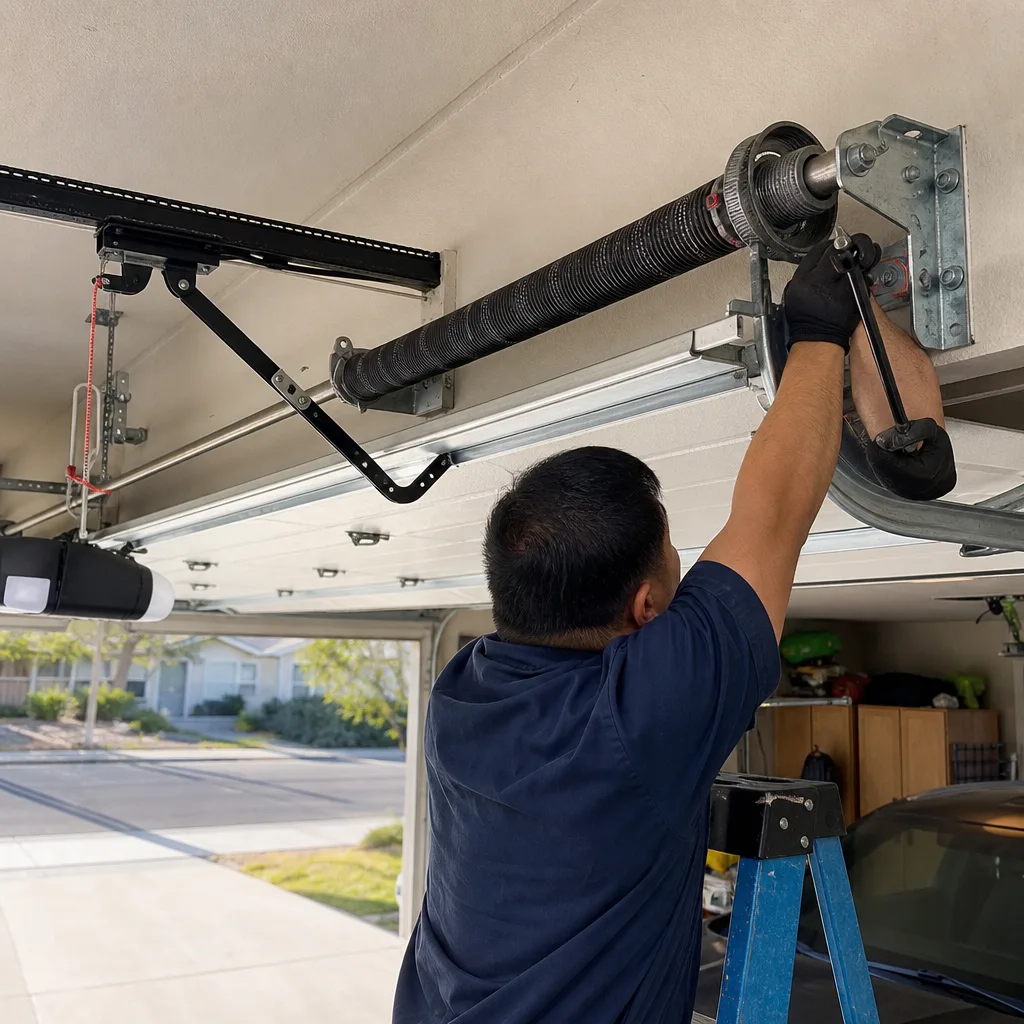
Torsion springs are wound tight. When installed correctly and under proper tension, the coils sit flush against each other with no visible gap. A healthy spring looks like a solid bar of coiled steel. When a spring starts to lose tension or develops a fatigue crack, the coils separate. You’ll see a small gap, often no wider than a dime, somewhere along the spring’s length. That gap is the spring telling you it’s no longer holding stable tension. It may still lift the door today. It will not be lifting the door in six months. If the gap appears suddenly, appears alongside the popping noise described earlier, or grows visibly between weekly checks, this is a Stop item. A spring that’s popping and showing a coil gap is the single strongest predictor we see of a spring break within days, not weeks. This is the wear pattern our technicians document most often in Thousand Oaks, because the dry heat accelerates fatigue cracking in spring steel. The climate works on these springs year-round, not just in summer.
Roller Wobble in Millimeters
Garage door rollers are small steel or nylon wheels mounted on a shaft that runs through a bearing assembly. A healthy roller spins true: no side-to-side movement if you put a finger on the wheel and try to wiggle it. A worn roller has play. You’ll feel it as a slight lateral click. The measurement that matters is two millimeters or more of side-to-side movement at the outer edge of the wheel. At two millimeters, the roller bearing is worn but may run for another few months. At four to five millimeters, the roller is done and should be replaced. The measurement doesn’t require precision tools. A millimeter is roughly the thickness of a credit card. If the wobble is more than the thickness of the card, schedule it. If the roller also shows visible flat spots on the wheel itself, where the wheel has stopped rolling and started dragging on the track, it’s now damaging the track. That turns a $15 roller replacement into a $150 track service. Rollers wear unevenly on a door that’s slightly out of balance, so check all the rollers, not just the noisiest one. The one that’s silent but wobbling is the one that will fail next.
The Slow Door Problem: Why Open vs. Close vs. Both Changes the Diagnosis
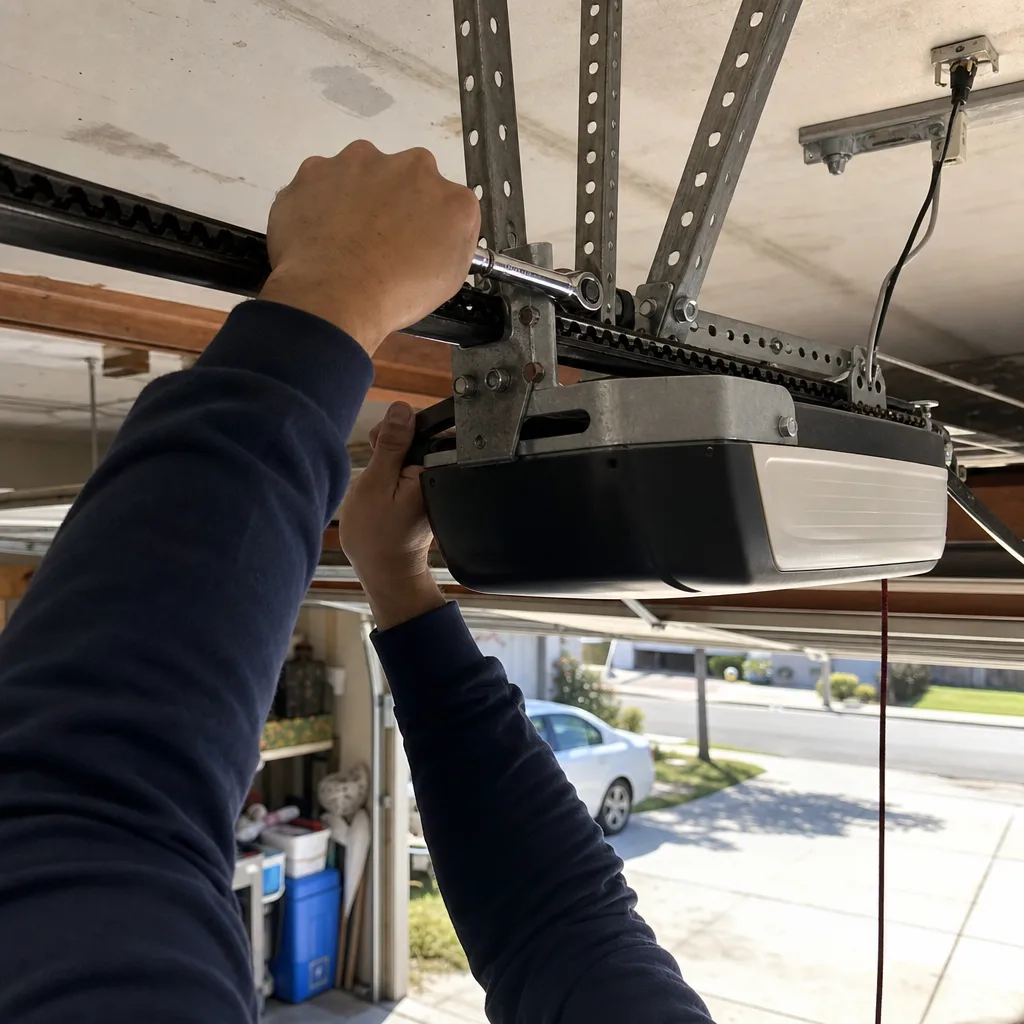
A garage door that’s running slower than it used to is a common warning sign, but “slow” is not a diagnosis. It’s a symptom with three different implications depending on when the door is slow. This is the point where a precise description saves a service call and gets the right part fixed on the first visit, which is how Garage Door Repair in Thousand Oaks should work in the first place.
Slow on Open Only
When the door labors on the way up but closes at normal speed, the problem is almost always in the lift mechanism, not the opener. The torsion springs are responsible for counterbalancing the door’s weight. When a spring loses tension, the opener motor has to work harder to lift the same weight. On a door that’s slow on open only, the spring is doing less of the work, and the opener is doing more. This is a spring tension issue, not a motor issue. It will not be cured by replacing the opener. The opener is a symptom amplifier, not the cause. What you’re hearing, if you listen closely, is the opener motor straining. That straining shortens the motor’s life. This is a Schedule item: the door will continue to function, but every cycle is wearing out both the opener and the weakened spring. On a door with two springs, the usual scenario is that one spring has lost more tension than the other, and the door is now lifting unevenly. The fix is a spring adjustment or replacement, depending on age and wire diameter.
Slow on Close Only
When the door is slow going down but opens normally, the likely causes are resistance in the tracks, a deteriorating weather seal dragging on the door edge, or a set of rollers that are binding under the specific load pattern of downward travel. Gravity should do most of the work on close, so a door that’s slow on close is a door that’s fighting friction. That friction is usually at the bottom of the track, where dirt, dust, and road grime accumulate. In Thousand Oaks, the fine sediment from the hills and the dry-season dust work their way into the track channels and mix with whatever lubrication is there to form a gritty paste. That paste increases rolling resistance. Cleaning the tracks and checking for bends or pinches is the first diagnostic step. A slow-on-close door is usually a maintenance item, not a structural one, unless the track itself has been damaged by impact or the door has shifted on its mounts.
Slow on Both Open and Close
A door that’s slow in both directions, noticeably slower than it was when it was installed, points to the opener itself. The motor is aging, the capacitor that gives it its starting surge is degrading, or the logic board is sending power inconsistently. This is most common in openers that are ten years old or older, which includes a good number of the original openers in Thousand Oaks homes built in the 2000s and 2010s. The diagnostic step is simple: pull the emergency release and open the door by hand. If the door moves smoothly and easily by hand, the door is not the problem. The opener is. If the door is heavy or sticky by hand, you’ve just discovered that the problem is the door, and the opener’s slower operation is a response to increased load. That two-minute test tells a technician exactly where to start, and it saves the diagnostic time that would otherwise be spent eliminating one side of the system before examining the other. When you call a contractor, tell them you performed the manual-open test and what you felt. That’s useful, specific information.
The Reversing Door: Why Cleaning the Sensors Usually Wastes Your Morning
The single most common garage door complaint we hear in Thousand Oaks is this one: “The door goes down about a foot and then comes back up.” The homeowner almost always assumes the photo-eye sensors near the floor are dirty or misaligned. They wipe the lenses, align the sensors, and try again. And when the door still reverses, they call us. Here’s what’s actually happening nine times out of ten with a door that reverses mid-close without a visible obstruction: the auto-reverse force threshold is doing its job.
Modern openers are equipped with a safety system that monitors the force the motor is applying during operation. If the door encounters resistance while closing, the opener reverses it. That system is designed to protect people, pets, and property from a closing door. What it’s also doing, all the time, is providing diagnostic information in the form of false reversals. When a door reverses with no obstruction in the photo-eye path, the force threshold is being tripped by mechanical resistance somewhere in the door’s travel. That resistance is almost always one of three things: worn rollers that no longer roll smoothly, a section hinge that’s binding, or a spring that’s lost enough tension that the door’s weight is no longer being properly counterbalanced and the opener is working against gravity and friction at the same time.
Here’s the counterintuitive part: the sensor eyes were never the problem. Cleaning them first wastes the thirty minutes of diagnostic time that would have identified the actual mechanical issue. The sensors are rarely the cause of a mid-close reversal on an interior garage door in a residential home. They sit low, they get dusty, but they’re designed to be tolerant of dirt. A sensor that’s actually misaligned will usually cause the door not to close at all, with the opener lights blinking a diagnostic code. A door that travels a foot, reverses, and travels back up is a door that’s fighting mechanical resistance. Treat it that way.
The correct diagnostic sequence is simple. First, observe whether the reversal happens at the same point in the door’s travel every time. If it does, that point is where the resistance lives, which narrows it to a specific section of track or a specific panel. Second, pull the release and operate the door by hand. If you feel the resistance, you’ve found the mechanical cause. If the door moves freely, the force threshold itself may need adjustment, which is an opener service issue, not a door issue. This is a Tier One warning sign, by the way, not because the door is about to fall, but because a door that doesn’t close is a door that leaves your garage, and everything in it, open to the street. In a city like Thousand Oaks where garages often contain not just cars but tools, bikes, and the chest freezer, a door that won’t stay closed is a security problem, not just a convenience problem.
If you’re dealing with a reversing door and you’ve already done the sensor cleaning, skip the YouTube deep-dive on force adjustment. That adjustment, done wrong, either makes the door unsafe (too much force, door won’t reverse on an obstruction) or unfixable (too little force, door reverses constantly). This is a Garage Door Opener Repair & Installation in Thousand Oaks item, and it’s one where the diagnostic precision matters more than the fix itself. A technician who adjusts the force threshold without identifying the mechanical cause has made the symptom quieter, not the problem smaller.
Thousand Oaks-Specific Factors: Heat, Dust, and Canyon Air
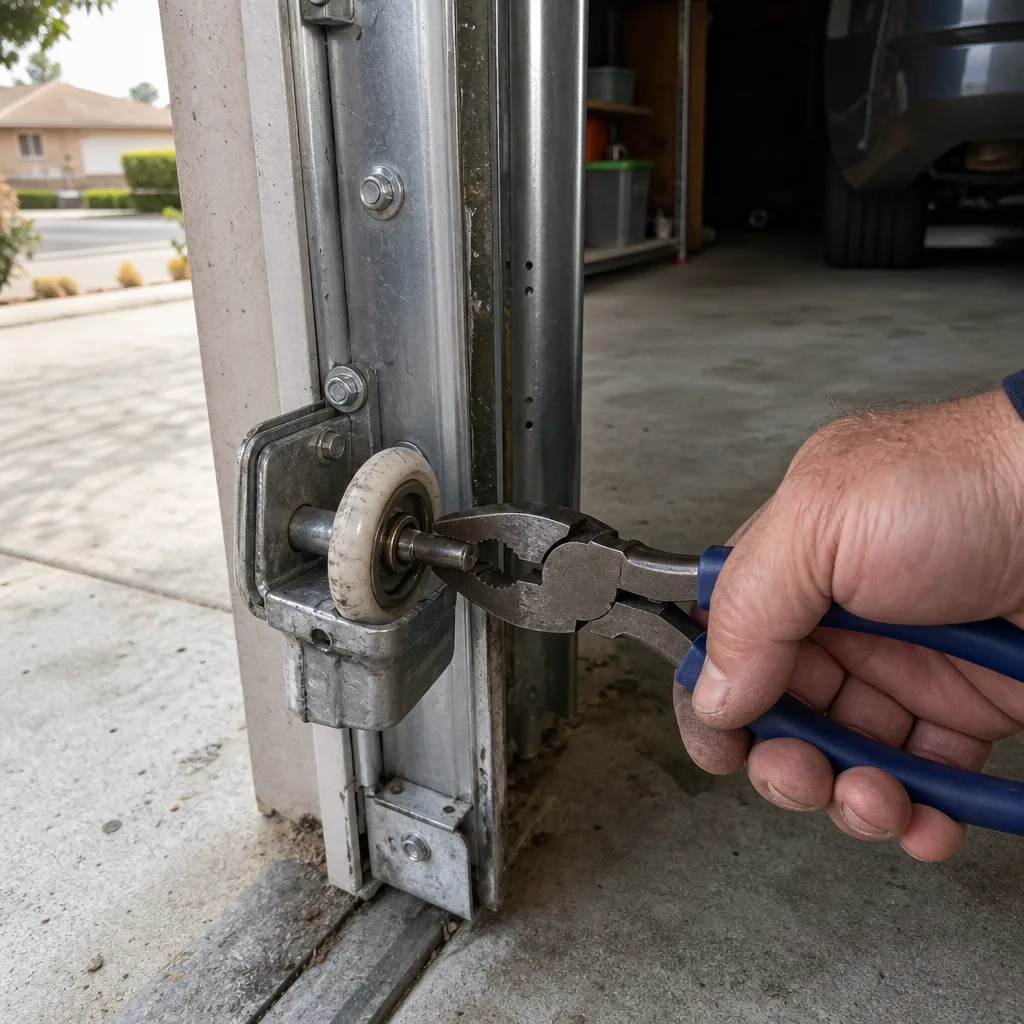
A garage door in Thousand Oaks does not wear the same way a garage door in San Francisco or Bakersfield does. The city’s climate sits in a specific band: hot, dry summers with sustained heat, cool damp winter mornings, and a consistent airborne sediment load. Each of those factors works on different components, which means the warning signs a Thousand Oaks homeowner should look for have a local profile.
Heat and spring fatigue. Torsion springs are rated for a certain number of cycles, usually 10,000, but that rating assumes a temperate environment. In a Thousand Oaks garage, where summer temperatures can push 95 degrees or higher inside an uninsulated garage, the spring steel expands and contracts with the daily temperature swing. Over five or six years, that expansion and contraction accelerates metal fatigue. We replace springs in Thousand Oaks more frequently than in coastal garages with the same cycle count. The warning sign of heat-related spring fatigue is the coil gap described earlier: it appears sooner, and it widens faster. If your door is more than six years old and the springs have never been replaced, check for a coil gap every month during summer.
Dust and the track system. The hills around Thousand Oaks are dry, and the wind moves fine sediment down the canyons and into the residential streets. That dust finds its way into the garage and settles in the track channels. Mixed with bearing grease, it becomes a grinding paste that scores the rollers and eats the track surface. The warning sign of dust-related wear is a grinding noise that’s present even right after cleaning, because the damage has already been done to the bearing surfaces. If you live in a canyon-adjacent neighborhood, clean your tracks more often and pay attention to grinding earlier than a homeowner in central Thousand Oaks would.
Canyon cold and condensation. Winter mornings in the Conejo Valley can be significantly colder at the canyon edges than in the city center. A garage door that’s cold-soaked overnight will have metal that’s contracted, which makes lubrication stiffer and squeaks more pronounced. A door that squeaks in December but is silent in July is probably not wearing out; it’s just cold. The diagnostic test is to note whether the squeak correlates with temperature. If it does, it’s seasonal. If the squeak is present on a 90-degree afternoon, that’s not the weather. That’s a hinge or a bearing.
What this means for maintenance. A Thousand Oaks homeowner who wants to minimize garage door repair should expect to inspect visible components twice a year, lubricate hinge pins and spring coils twice a year, and replace rollers every five to seven years depending on dust exposure. See our Seasonal Garage Door Care for Thousand Oaks: Year-Round Homeowner’s Guide for a complete schedule. The city’s climate doesn’t create exotic problems. It just accelerates the ordinary ones.
How to Describe a Warning Sign to a Contractor Without Wasting a Service Call
The fastest way to add a return visit to your garage door repair bill is to describe the problem imprecisely. “It’s making a noise” tells a technician nothing. “It makes a grinding sound at the bottom two panels, only when opening, and it’s been getting louder for six weeks” tells the technician which rollers are likely failing, which means the correct parts are on the truck when it pulls up. Here’s the vocabulary we use internally, and what it means, so you can use it on the phone.
- Name the direction. Does the problem happen on open, on close, or both? “It grinds on open only” eliminates half the possible causes immediately.
- Name the location. Top of the door, bottom of the door, left side, right side, the track, the opener, the spring. “The grinding is at the bottom left roller” is a different diagnosis than “the grinding is somewhere in the door.”
- Name the sound, not the impression. Grinding is metal on metal. Squeaking is rubbing without a bearing. Popping is a spring releasing tension. Rattling is loose hardware. “It sounds like a squeak” is precise. “It sounds like the door is struggling” isn’t.
- Name the duration. Has this been happening for a week, a month, or since you moved in? A problem that’s been present and unchanged for three years is a different scenario than a problem that appeared last Tuesday.
- Name what you’ve already tried. If you lubricated something, cleaned the sensors, or adjusted anything, say so. We won’t be annoyed. We’ll be better informed. “I sprayed the hinges with WD-40” is useful because it tells us the lubrication may be stripped, not just absent.
This precision is the same discipline we apply at every service visit. The written scope we provide before any work starts is written in the same vocabulary: the component name, the measured condition, the proposed repair, and the flat price. Clause 1 of The Haven Standard is why the price on that scope is the price you pay. No exceptions. No “call for a quote” ambiguity. If you can describe what you’re seeing in these terms, we can quote accurately over the phone in most cases, or we can tell you honestly that we need to see it before we can name the price. Either way, you know exactly where you stand before anyone schedules anything.
Common Mistakes to Avoid
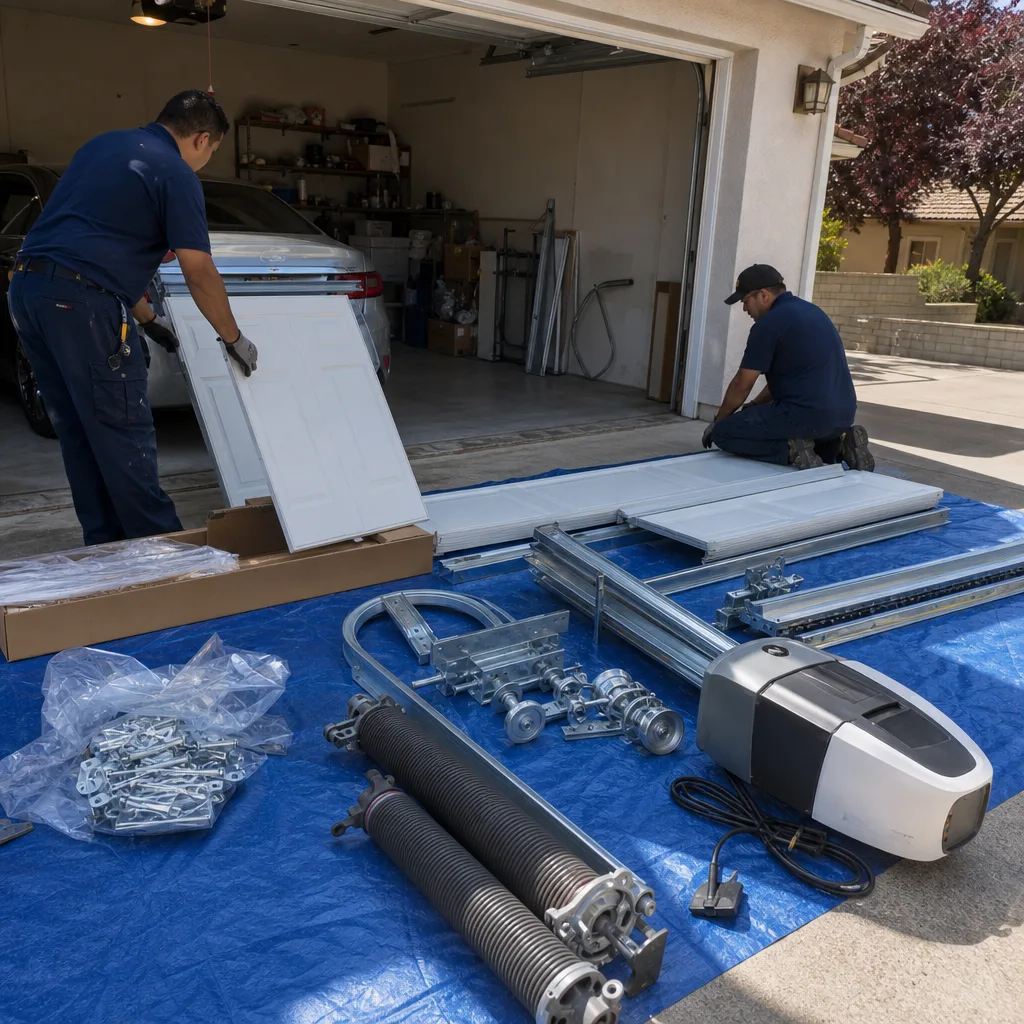
- Cleaning the photo-eye sensors before investigating mechanical resistance. This is the top misdiagnosis we see in Thousand Oaks. The sensors are rarely the problem when a door reverses mid-close without an obstruction. You’ve spent thirty minutes cleaning lenses while the roller bearing continues to wear. When the door still reverses, you’ve lost the diagnostic window that would have identified the cause earlier.
- Using WD-40 on garage door hardware. WD-40 is a water displacer and solvent. It strips the existing grease from hinge pins and spring coils and leaves them drier than before. Use white lithium grease on hinges and springs. Do not use WD-40 on any component.
- Ignoring a popping spring because “the door still opens.” The door is still opening because the spring hasn’t fully failed yet. When it does fail, it will not give you a warning the day before. The popping was the warning. A popping spring with a visible coil gap is a Stop item.
- Operating the door with a visibly broken spring. This one is common and dangerous. A torsion spring break removes the counterbalance from the door’s weight. The door becomes dead weight. Trying to open it with the opener or by hand puts strain on every other component and risks the door falling or the cable snapping. If the spring is broken, leave the door where it is and call for service.
- Assuming “the opener is bad” without testing the door manually. Opener motors get blamed for spring problems constantly. Pull the release and open the door by hand. If it’s heavy, the springs are the issue. If it’s smooth, the opener is suspect. That two-minute test is free and it prevents you from paying for an opener replacement you didn’t need.
- Ignoring a grinding noise because “it’s been doing that for a while.” Duration is not a sign that a problem is harmless. A roller that’s been grinding for six months has been chewing its bearing for six months, and it’s now closer to failing than it was. The damage is cumulative. Early replacement costs less.
- Calling for help without describing the symptom precisely. “The garage door is broken” gets you a technician with a generic truck. “The door is slow on open, pops from the spring area, and the right roller wobbles about 3 millimeters” gets you a technician with the right springs, the right roller, and a diagnosis already half-formed. Precision saves you money on the first visit. That’s how our service works in Thousand Oaks: the evidence goes on the paperwork before the price is ever agreed upon.
When to Call a Professional
Call a professional when the warning sign is a Stop item, when a Schedule item has been present for more than 30 days without resolution, or when you’ve performed the simple diagnostics in this guide and still can’t identify the cause. Specifically: a broken or gapped spring, a frayed cable, a door that reverses and won’t stay closed, a door that jerks sideways, or any grinding that’s been present for more than a few weeks. These are not DIY items. A torsion spring holds enough stored energy to cause serious injury. A cable under load can snap and whip. The components are under tension, and the margin for error is small. Garage Door Installation in Thousand Oaks work and its accompanying repair work should be left to someone who carries the license on the page, not buried in fine print. Servo Garage Doors Thousand Oaks offers free estimates in Thousand Oaks. Call (424) 395-3203. We’ll name the price, in writing, before any work starts. That’s Clause 1, and we’ve been doing it that way since 2015.
Frequently Asked Questions
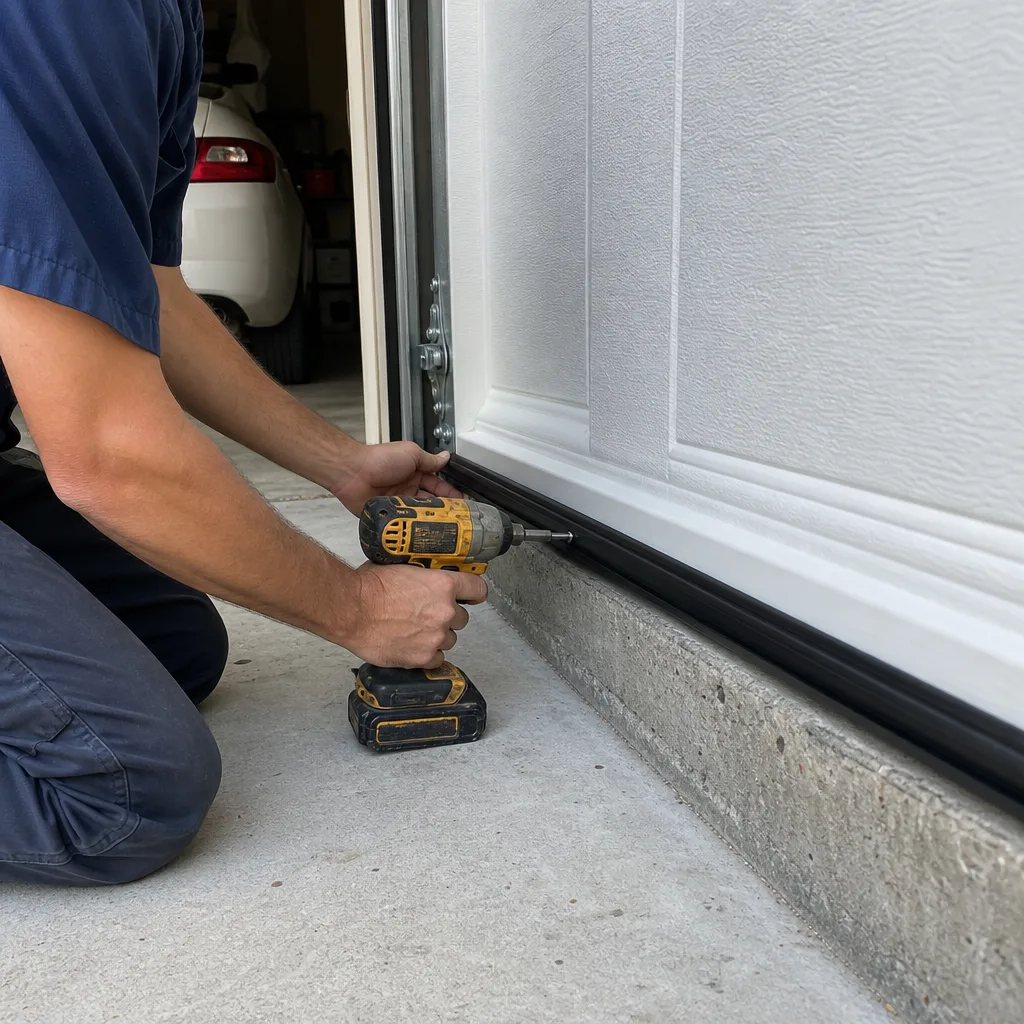
Garage door spring repair in Thousand Oaks typically costs between $180 and $340 per spring including labor, depending on spring size and wire diameter. Most doors have two springs, and the common recommendation is to replace both at once since they wear at identical rates. Servo Garage Doors Thousand Oaks provides a flat, written price and written scope before any work starts, so the quote on paper is the price you pay. Call (424) 395-3203 for an exact quote. Estimates are free, and the price is written before anything is touched.
A garage door that reverses mid-close with no visible obstruction is reacting to mechanical resistance, not a sensor problem. The auto-reverse force threshold is tripping because rollers, hinges, or springs are creating friction that was not present before. Start by pulling the release and operating the door by hand to feel where the resistance is. Servo Garage Doors Thousand Oaks diagnoses this issue regularly, and the fix is almost always mechanical, not sensor-related. Call (424) 395-3203 for a free diagnostic, and we’ll tell you what we find before we touch anything.
Yes, same-day spring replacement is usually available in Thousand Oaks. Broken springs are one of the most common emergency calls we handle, and our trucks carry the most-used spring sizes for the door brands common in the area, including Clopay and Amarr. Call (424) 395-3203 and describe the spring: single or double, and the color of the paint stripe if you can see one. That tells us the wire diameter and lets us confirm the part before we dispatch. Live phone coverage, 24/7, and a named technician with an on-the-way text, not a callback window.
A popping sound from a garage door means a torsion spring is slipping under load, releasing tension in small increments rather than winding smoothly. It’s the warning sign that most reliably precedes a spring break, especially if it’s accompanied by a visible gap between the spring coils. Stop using the door if you see both. Servo Garage Doors Thousand Oaks includes a documented photo record on every visit, so you’ll see the failed component before any replacement is quoted. Call (424) 395-3203 for a free estimate.
How often should I lubricate my garage door in Thousand Oaks?
Twice a year is the right rhythm for Thousand Oaks, where canyon dust and summer heat work on lubrication faster than in coastal climates. Apply white lithium grease to hinge pins, roller bearings, and torsion spring coils. Do not use WD-40; it strips lubrication. If you hear grinding even right