
Last updated September 20, 2026
Full 25-point door and opener safety check with every visit - springs, cables, rollers, tracks, and your LiftMaster or Chamberlain opener included
You get a price before we start. It does not change when the truck arrives.
 Before
 After
After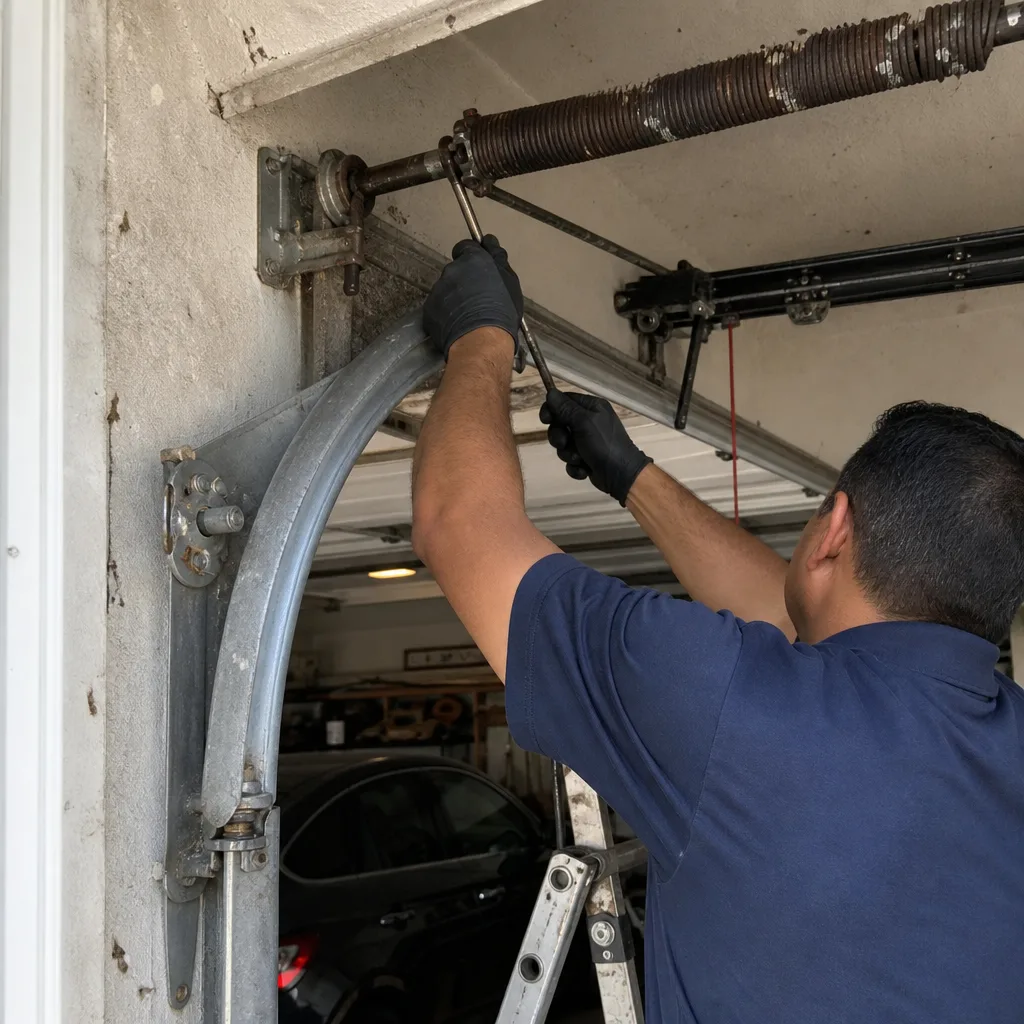 Before
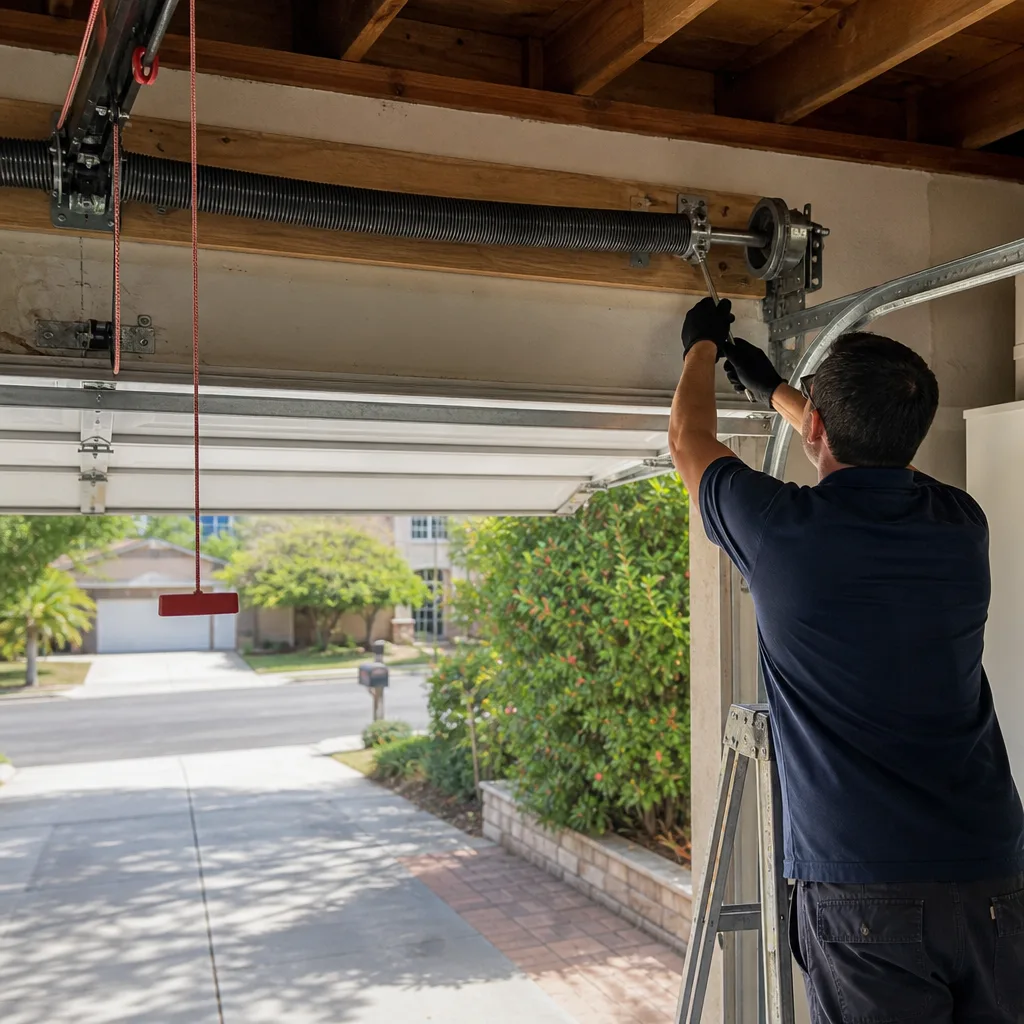 After
After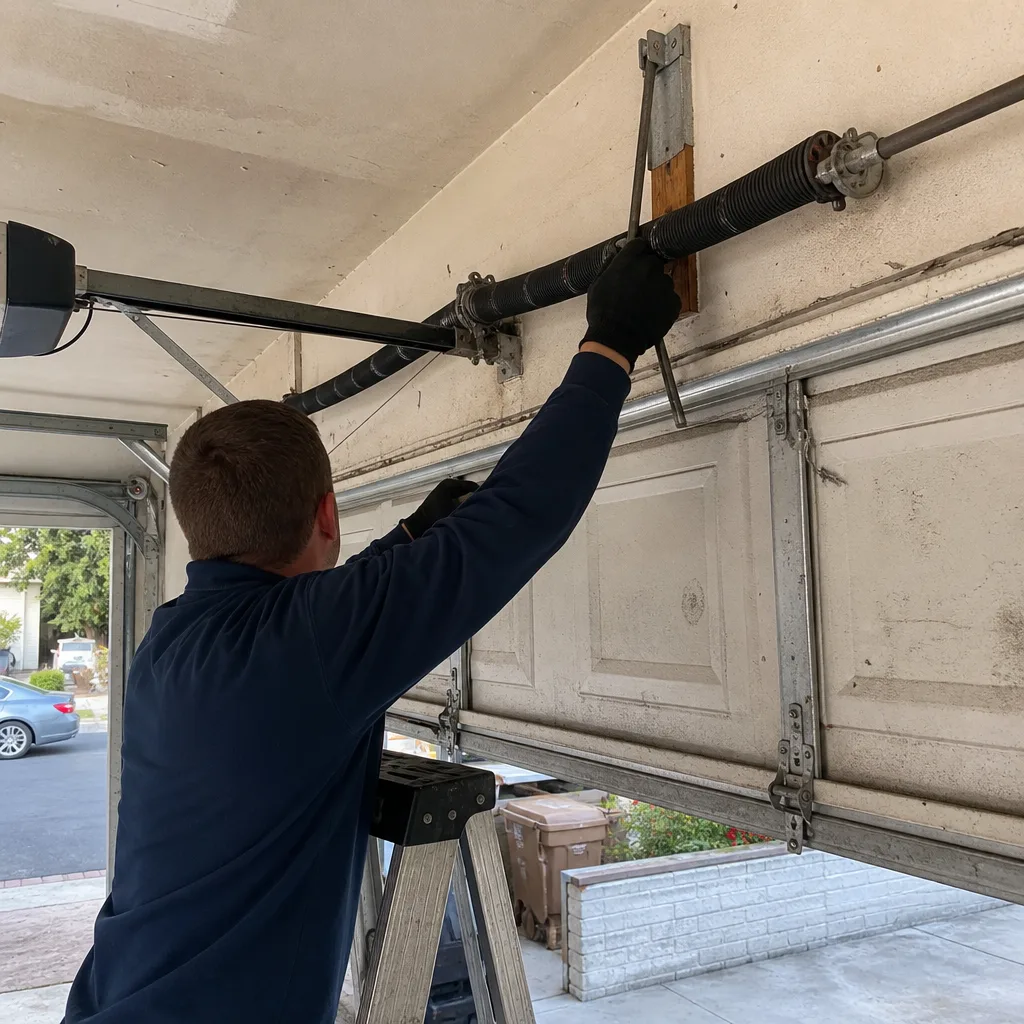 Before
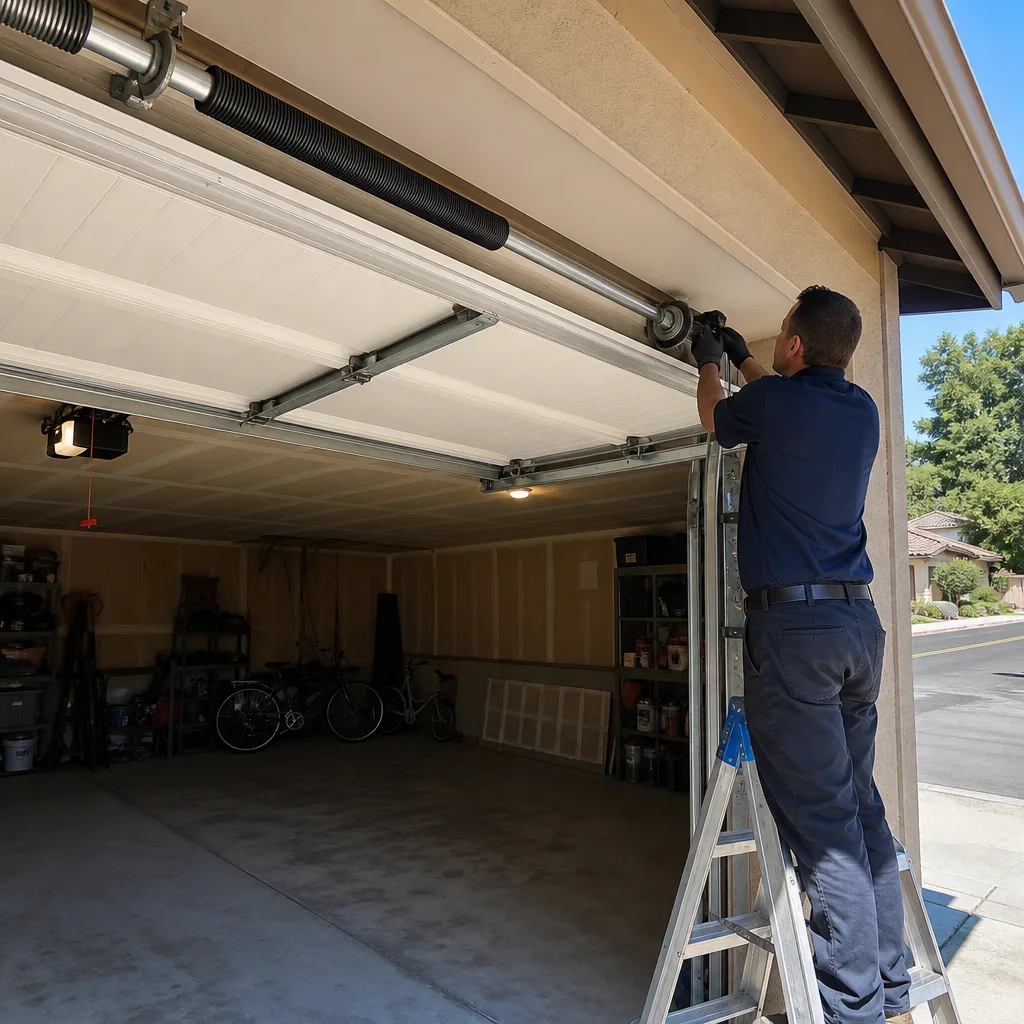 After
AfterThe Complete Guide to Garage Door in Thousand Oaks
Here’s a number most Thousand Oaks homeowners won’t believe: a standard residential garage door weighs between 130 and 400 pounds. The only reason it opens with two fingers is a system of calibrated counterweights and bearings working in sequence. When one component in that sequence fails, the others take the load, and that’s when a $40 roller replacement becomes a $900 track rebuild. This guide maps every component of your garage door system, what each part costs to replace in the Thousand Oaks market, and how to read an estimate before you sign it. For a deeper look at pricing, see our Garage Door Cost Breakdown: The Thousand Oaks Homeowner’s Reference for 2026. You’ll finish with a working knowledge of the largest moving object in your home, and a decision framework no contractor can out-argue.
Quick Answer
A garage door in Thousand Oaks is a six-component system: springs, cables, rollers, tracks, opener, and panels. Most failures trace to three of them, springs, rollers, and opener logic boards, and most replacements cost between $150 and $450 per component in the Conejo Valley market. A documented, written estimate with photos of the failed part should be the minimum standard before any work starts, and in Thousand Oaks, that standard is codified in writing, not promised verbally.
Table of Contents
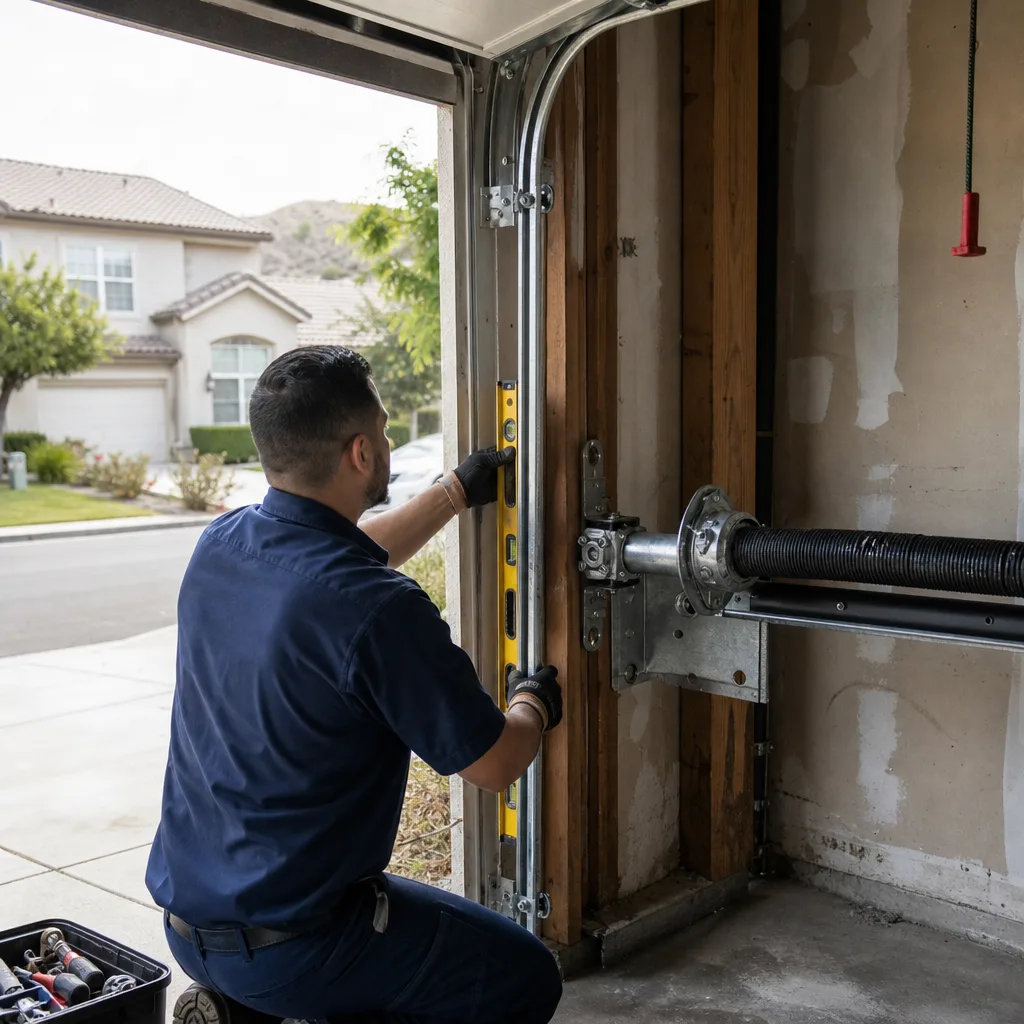
- The Six Components of a Garage Door System
- What Each Component Costs to Replace in Thousand Oaks
- How the Conejo Valley Climate Changes Failure Rates
- What a Written, Photo-Documented Estimate Looks Like
- Ventura County Permit Thresholds for Garage Door Work
- Repair vs. Replace: A Decision Tree That Doesn’t Come From a Sales Script
- Brand Notes: LiftMaster, Chamberlain, and Genie in the Field
BeforeAfterThe Six Components of a Garage Door System
A garage door is not one product. It is six subsystems that share a common track and rely on each other to move safely. When a Thousand Oaks homeowner calls us with a vague report, usually “it’s making a grinding noise,” the first job is identifying which subsystem is talking. Here is each component, what it does, and what its failure sounds like.
1. Torsion Springs
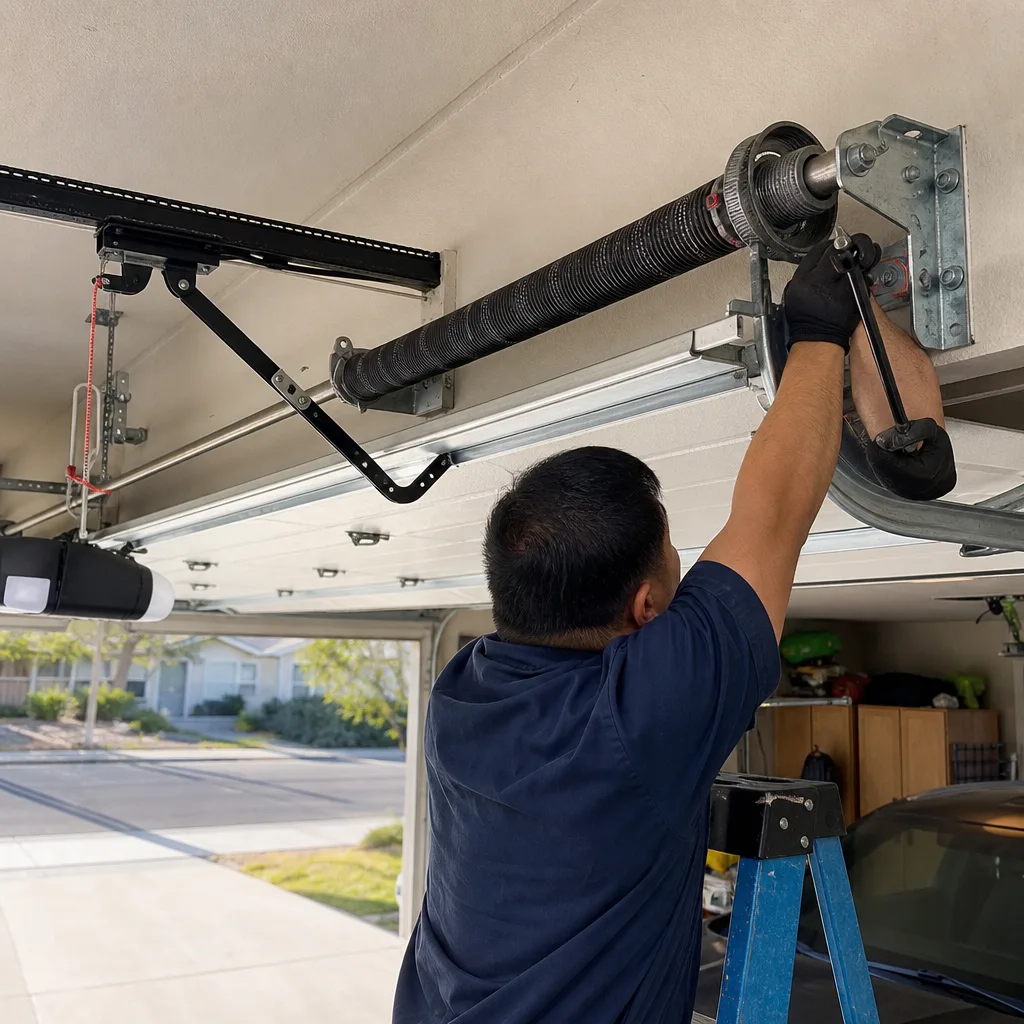
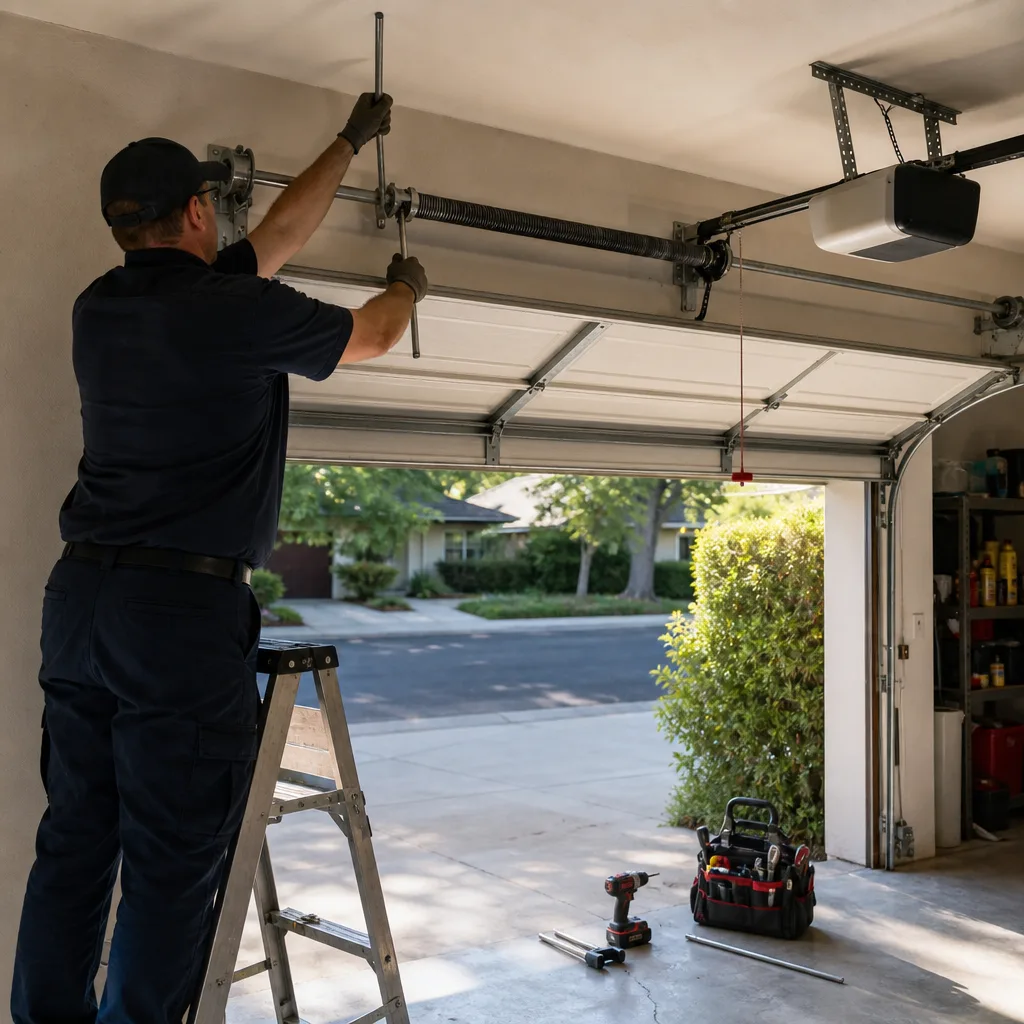
The torsion spring is a coiled steel shaft mounted above the door opening. It stores the mechanical energy that makes the door feel light. When you hear a garage door described as “balanced,” what’s being described is the relationship between the spring’s torque and the door’s weight. A standard torsion spring is rated for a cycle count, typically 10,000 open-close cycles, which translates to roughly seven to ten years of normal residential use in Thousand Oaks. When one breaks, it is unmistakable: a sharp bang that sounds like a dropped rifle, then a door that either won’t lift or crushes down if lifted manually.
We photograph every spring we replace. The photo shows whether the break was fatigue-initiated, a clean snap at a coil, or corrosion-accelerated, which presents as pitting along the wire surface before the break. That distinction matters because it tells you whether the other spring should be replaced too, and in most cases it should. Springs are replaced in pairs. If one spring has cycled out, its partner has cycled the same number of times.
2. Cables
Cables are the braided steel lines that run from the bottom brackets of the door, up the vertical track, and around the cable drum above. Their job is singular: they transfer the spring’s lifting force to the door itself. Under Conejo Valley conditions, cables fail two ways. Fraying, which happens slowly and is visible on inspection, and sudden snap, which happens when a frayed cable is ignored. A broken cable is a dangerous condition because the door becomes unwinding, off-balance, and unpredictable. When a cable on one side lets go, the remaining cable takes the entire load alone.
One Thousand Oaks-specific note: many homes in the Dos Vientos and Newbury Park areas were built during construction booms where developers used galvanized cable hardware. In a dry climate like Conejo Valley’s, that choice works for years. But galvanized coating wears thin where the cable rides the drum, and once the raw steel is exposed, a relatively humid winter morning in Thousand Oaks can accelerate the rust. We check cable condition on every service visit, and we photograph any fraying we find, even if the customer only called about a noisy opener.
3. Rollers
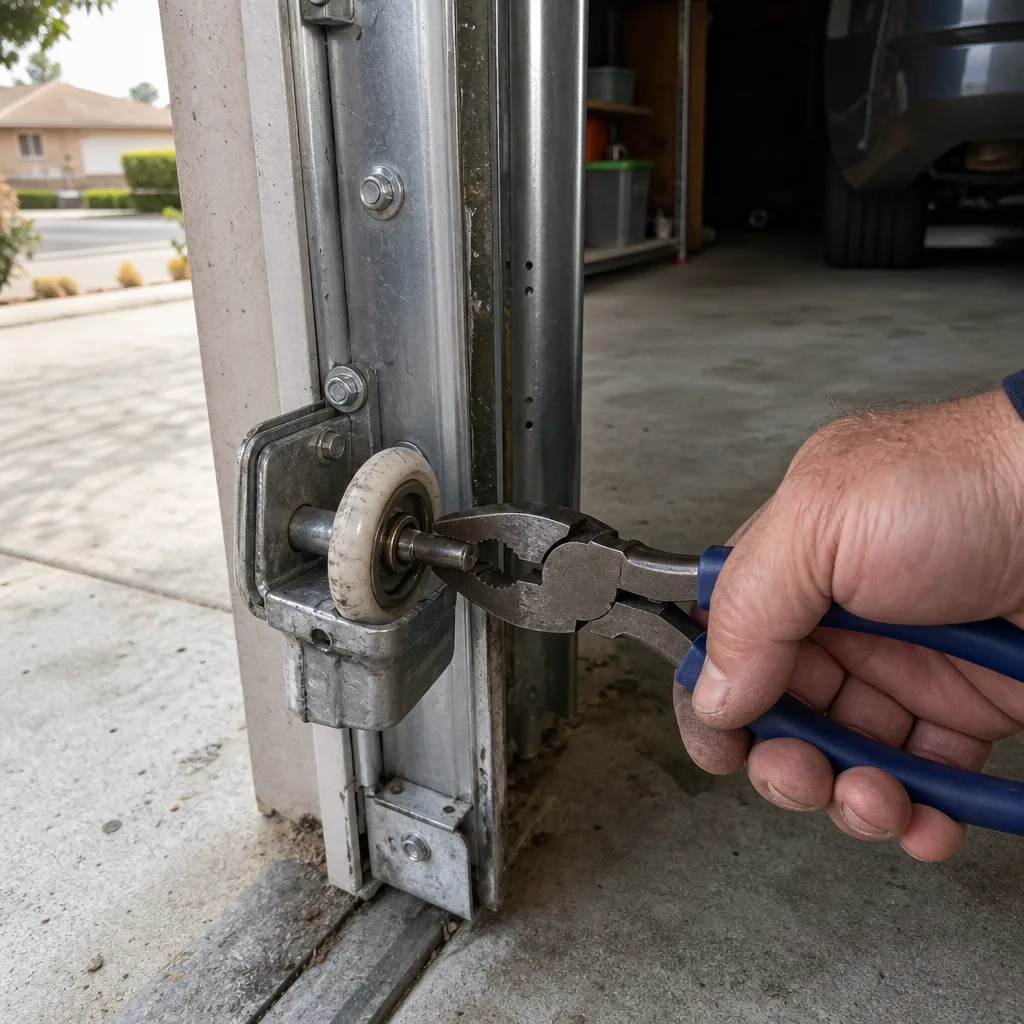
Rollers are the small wheels that carry the door up and down the track. Steel rollers last three to five years under normal Thousand Oaks use before the bearings inside them wear out. Nylon rollers with sealed bearings run quieter and last longer, typically seven to ten years. When a roller bearing fails, the wheel stops rolling and starts sliding, which is the “grinding” noise that drives most of the service calls we answer in Thousand Oaks.
The cheapest fix in the garage door industry is replacing a single roller. The most expensive mistake is replacing rollers when the real problem is a bent track pinching the wheels against the guide. A photo-documented inspection tells the difference in thirty seconds, because the failed roller shows flat spots on its surface, and a bent track shows the wear pattern migrating along the track wall. If a technician can’t tell you which roller failed by number, from the bottom up, they haven’t looked at the door.
4. Tracks
Tracks are the vertical and horizontal channels the rollers travel through. They are the garage door’s spine. A track that is dented, bowed, or out of parallel will wear out every roller and hinge in the system within months. In Thousand Oaks, the most common track damage we see is from vehicle contact, cars being parked two inches too close and clipping the vertical guide on the way in. It happens in the cramped garages of Westlake Village, in the tight two-car setups through Wildwood, and in every tract development where standard garage widths were designed for 1990s sedans, not modern SUVs.
Track replacement is rarely about the metal. It’s about realignment. A new track installed without checking the door’s balance and the opener’s force settings will simply recreate the problem in a new location. When we quote track work in Thousand Oaks, the written scope includes realignment, roller replacement if indicated, and a balance test. The track itself is the cheapest part of the job.
5. The Opener
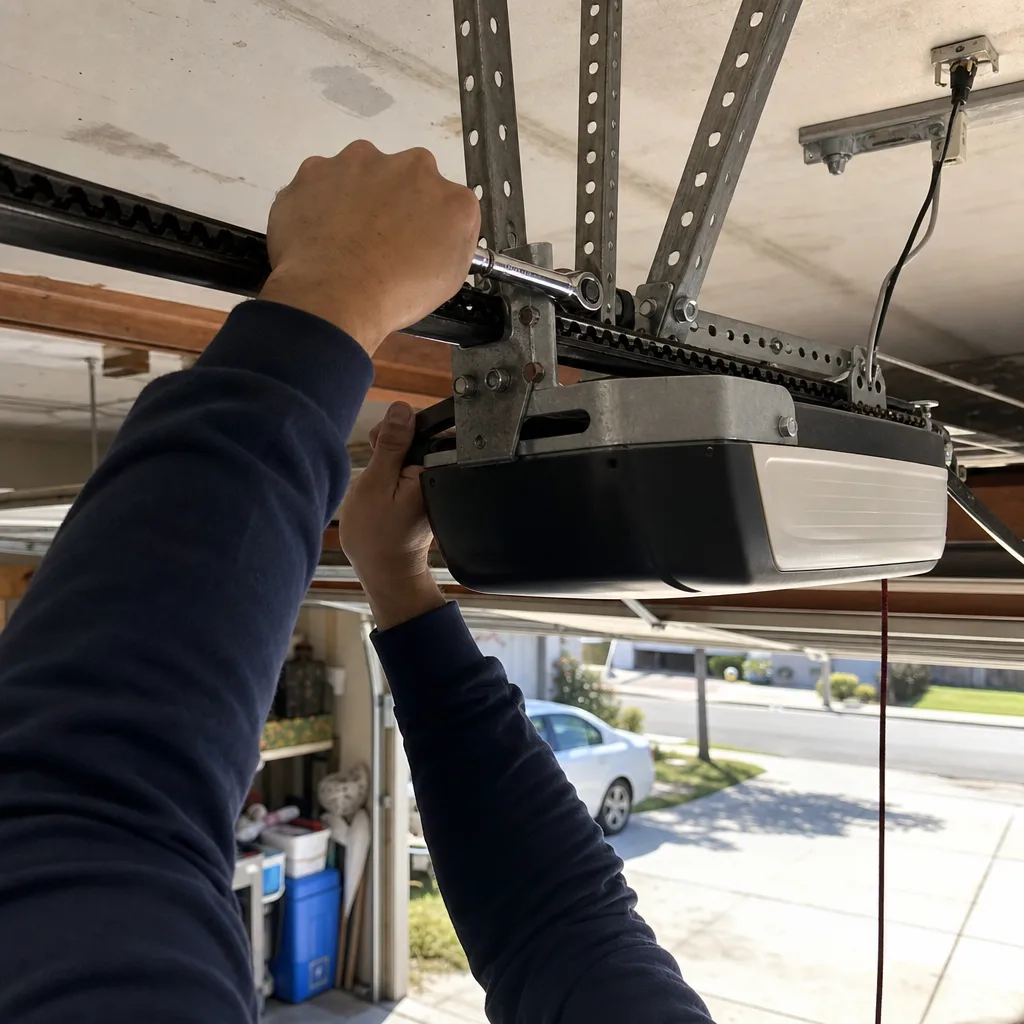
The opener is the motorized unit that does the pulling. It is the component homeowners know best and understand least. Inside the housing is a logic board, essentially a small computer, a limit switch assembly that tells the motor when to stop, and a drive system, either chain, belt, or screw, that connects the motor to the door. When a Thousand Oaks customer says the door opens halfway and reverses, we’re checking the limit switch. When the remote works but the wall button doesn’t, we’re checking the safety sensor circuit. When the opener runs but the door doesn’t move, we’re checking the drive gear or the trolley carriage, the component that attaches the drive rail to the door arm.
Opener repair in Thousand Oaks is usually a component replacement, not a whole-unit replacement. A logic board for a LiftMaster or Chamberlain opener typically runs $120 to $180 in parts. A full opener replacement runs $400 to $700 installed, with belt-drive units at the higher end. The delta between those numbers is why a written estimate before work starts matters. If the technician can’t identify the failed component and can only offer “a new opener,” you haven’t received a diagnosis. You’ve received a sales pitch.
6. Panels
Panels are the visible sections of the door, typically four or five horizontal steel or aluminum sections hinged together. Panel damage in Thousand Oaks falls into three categories: cosmetic denting, structural buckling, and seal failure. A dented panel is a cosmetic choice. A buckled panel, one that has lost its internal foam core and is bending under its own weight, is a structural problem that affects the door’s balance and the wear on every other component. A failed bottom seal at the panel’s base is the most common Thousand Oaks-specific issue, and it’s less about the seal itself than what it lets in: dust, spiders, and in wildfire season, embers.
Panel replacement is priced per panel, not per door. A single steel panel in the Thousand Oaks market runs $250 to $450 installed, depending on gauge and insulation value. The question is whether the door’s age and panel availability make that money wise, a decision tree we cover below.
What Each Component Costs to Replace in Thousand Oaks
These are the prices Thousand Oaks homeowners should expect on a written estimate in 2026, before any work begins. The ranges reflect material cost and labor for a standard residential door. They are not the cheapest available option and they are not inflated by urgency markup. If a quote falls outside these ranges by a wide margin, ask for the scope in writing.
| Component | Typical Repair Cost | Typical Replacement Cost | Expected Lifespan in Thousand Oaks |
|---|---|---|---|
| Torsion spring (pair) | N/A (springs are not repaired) | $280-$450 | 7-10 years |
| Extension spring (pair, older doors) | N/A | $200-$320 | 5-8 years |
| Cable (per side) | $95-$150 | $180-$260 for both sides | 10-12 years, inspect annually |
| Roller (per unit) | $15-$25 | $40-$60 for nylon upgrade | 3-5 years steel, 7-10 nylon |
| Track (single side) | $120-$180 realignment | $200-$350 with replacement | 20+ years barring impact |
| Opener logic board | $150-$220 installed | N/A (board swap is the replacement) | 7-10 years |
| Full opener (belt drive) | N/A | $450-$700 installed | 10-12 years |
| Single steel panel | N/A | $250-$450 installed | Matches door age |
| Bottom seal and weatherstrip | $80-$130 | N/A (seal is the replacement) | 4-7 years |
Every one of these numbers is a flat, written price before work starts. Clause 1 of The Haven Standard exists because verbal quotes have a way of growing between the driveway and the invoice. The price you agree to is the price on the invoice. That has been true on every job Servo Garage Doors has done in Thousand Oaks since 2015.
How the Conejo Valley Climate Changes Failure Rates
Thousand Oaks sits in a climate niche that doesn’t match the coast and doesn’t match the inland valleys. Daytime summer temperatures regularly cross 90 degrees in Westlake Village and southern Newbury Park, while overnight lows stay in the 50s. The air is dry, with average annual humidity under 50 percent. That’s good for steel, mostly. It is hard on rubber, seals, and coatings.
What fails faster in Conejo Valley’s environment:
- Bottom seals and weatherstrips. UV exposure in Thousand Oaks runs 280 to 320 sunny days per year. Rubber compounds dry out, crack, and lose their compression set. A bottom seal in coastal Oxnard might last seven years. The same seal in Thousand Oaks lasts four to five before it starts letting light and dust through.
- Spring coatings and wire surfaces. Low humidity slows rust, but Thousand Oaks sits close enough to the ocean that June and July morning marine layer rolls over the Santa Monica Mountains. That brief morning moisture, combined with daytime drying, creates a cyclic wet-dry environment that opens micro-fractures in spring coating. When we photograph a spring with corrosion pitting in Thousand Oaks, the pattern is almost always coastal-morning moisture, not rain exposure.
- Nylon bushings in rollers and hinges. High heat accelerates polymer degradation. Nylon rollers last closer to seven years here than the ten they might achieve in cooler, cloudier markets.
What fails slower in Thousand Oaks:
- Steel panel rust-through. The dry climate means panel faces rust far less than in beach cities. A Thousand Oaks steel door with intact paint will outlast an identical door in Santa Monica by several years.
- Track rust. Galvanized tracks hold up well in this climate, provided they haven’t been scratched or dented to bare metal by vehicle contact.
The practical takeaway: your inspection budget in Thousand Oaks should go to rubber and spring steel, not to panel rust. Every service visit worth paying for includes a seal and spring condition check, photographed, with notes. If the technician doesn’t mention your bottom seal, they didn’t look at the door.
What a Written, Photo-Documented Estimate Looks Like
In California, a verbal quote is legally enforceable only with difficulty, and a verbal scope is not enforceable at all. What you want, and what a professional operation provides without being asked, is this:
- The failed component identified by name. Not “the springy part.” It says “torsion spring, right side, measured at 0.225-inch wire diameter.”
- A photograph of that component, included in the estimate. Clause 4 of The Haven Standard requires the technician to photograph the failed part before quoting a replacement. You see what they saw. No photograph, no reason to approve the quote.
- A written scope of work. What gets removed, what gets installed, what gets adjusted. This is the document that prevents the “while I’m in there” upsell on invoice day.
- A flat price, in dollars. Not a range, not a “depends on what we find.” The price is the price. If the technician finds additional work needed, that is a new written estimate, not a revised invoice.
- A stated warranty period. What’s covered, for how long, and what voids it. The 365-Day Done Right Promise means a repair that fails within the year gets corrected. That promise is written, not verbal.
This is the minimum standard every Thousand Oaks homeowner should hold any garage door contractor to. It is the founding rule Servo Garage Doors was built on in 2015: show the customer the broken part before asking them to pay for a new one. The rest of the industry has had ten years to catch up.
Ventura County Permit Thresholds for Garage Door Work
Here is the answer most Thousand Oaks homeowners never get from a contractor: most garage door repairs do not require a permit in Ventura County. For the full picture, read our guide to Garage Door Permits, Codes & Inspections in CA: What You Need to Know. Replacing a spring, a cable, a roller, or an opener is classified as repair work, not construction, and is done under the contractor’s license without a city or county permit. The same applies to replacing the door itself, provided the opening is not being altered, even when the new door is heavier or insulated.
Where the permit threshold changes:
A permit is required when the opening size changes, when you widen, heighten, or structurally modify the garage entry. That’s not a garage door job. That’s a framing job, and it falls under Ventura County’s building permit requirements for structural modification.
A permit may be required when converting a garage to living space. If the door is being removed entirely and the opening is being walled in, the city of Thousand Oaks requires plans and permits. This is far beyond the scope of door replacement.
HOA review may apply in many Thousand Oaks neighborhoods. This is not a county permit, but it functions like one. Developments in Westlake, North Ranch, and Dos Vientos have architectural review committees that must approve door styles, materials, and even colors before installation. The county won’t care if you switch from steel to glass-paneled aluminum. Your HOA might. A professional installer who works in Thousand Oaks daily will know which communities have active review requirements and will flag the HOA step before the order is placed, not after the door arrives.
The practical rule: if you’re repairing or replacing a door within the existing opening, no county permit. If you’re changing the opening or the door’s function, check with the city of Thousand Oaks building department and your HOA. Anyone who tells you a permit is always required for a door swap is selling you anxiety.
Repair vs. Replace: A Decision Tree That Doesn’t Come From a Sales Script
Most garage door companies want you to replace the door. That’s where the margin lives. Before you decide, consider our DIY vs Professional Garage Door: The Thousand Oaks Homeowner’s Decision Guide. Here is the decision tree we use in Thousand Oaks, and the one we recommend homeowners run themselves before calling anyone:
Step 1: How old is the door? Under eight years old, repair almost always wins. Springs, rollers, and cables are wear items designed to be replaced before the door itself. Replacing a six-year-old door because of a broken spring is like replacing a car because it needs brake pads.
Step 2: How many panels are damaged? One dented or buckled panel, and the door is under ten years old, panel replacement makes sense. Two or more panels, or damage that spans a hinge line, replacement usually wins because the cost of two or three panels approaches the cost of a new door, and you’re still left with a foot of aging hardware.
Step 3: What is the spring cycle count? If the door is on its second set of springs and the opener is original, you’re at the point where the mechanical infrastructure is ending its service life at the same time. This is a replacement door’s moment, not because the door looks bad, but because you’ll replace the works anyway, and a new door comes with new works.
Step 4: Is the door’s function still matching the household? A lot of Thousand Oaks homeowners are one EV purchase away from needing a different door configuration, a taller opening, a heavier insulated door for a workshop conversion, or a high-lift track for a car lift install. If the door’s job is changing, repair is wasted money.
Step 5: Show me the photograph. Whatever the recommendation, the evidence should be visible. A broken spring, a buckled panel, a stripped drive gear: any of these can be photographed and shown to you. If the technician can’t produce an image of the failure that justifies a replacement door, call someone else.
We’ve run this decision tree on thousands of Thousand Oaks doors. It points to repair more often than homeowners expect, because most doors in this city are younger than their owners think, and most replacement pitches cite cosmetic issues as structural ones. The photo is the antidote to that.
Brand Notes: LiftMaster, Chamberlain, and Genie in the Field
We service all eight major door and opener brands, and in Thousand Oaks, the opener market is dominated by three names: LiftMaster, Chamberlain, and Genie. Each has a distinct repair profile in this market.
LiftMaster is the professional-installation brand, and in Thousand Oaks, it accounts for roughly half of the openers we see on doors installed after 2015. Its failure profile is board-related: logic board failures from power surges, which happen often enough in neighborhoods served by above-ground utility lines, including parts of Newbury Park and the hillside areas off Lynn Road. The mechanical components, the drive gears and trolley carriages, tend to be robust. When a LiftMaster fails, it’s usually the brain, not the muscle.
Chamberlain is LiftMaster’s consumer-line sibling, sold at big-box stores and installed by homeowners or handymen. The components are similar, but the install quality varies widely. The failure we see most in Thousand Oaks is photo-eye misalignment, a safety sensor fault that stops the door from closing. This is a two-minute adjustment on most units. We’ve quoted this job more times than we can count, and we always photograph the sensor alignment before and after, because the before photo shows the customer what was wrong, not just that it’s now fixed.
Genie openers are less common in Thousand Oaks but present in older homes, particularly in the Conejo Valley tracts built between 1980 and 2000. Genie’s signature failure is the drive belt tensioner, which loosens over time and causes the door to slip or stall. It’s a known issue, documented widely, and it’s a relatively inexpensive fix. The mistake is thinking the whole unit is dead when it’s just a belt that needs tensioning.
On the door side, Clopay and Amarr account for the majority of residential doors in Thousand Oaks, with steel construction and foam insulation being the default choices. Both brands hold up well in this climate, provided the bottom seals are maintained on the schedule above.
Common Mistakes to Avoid
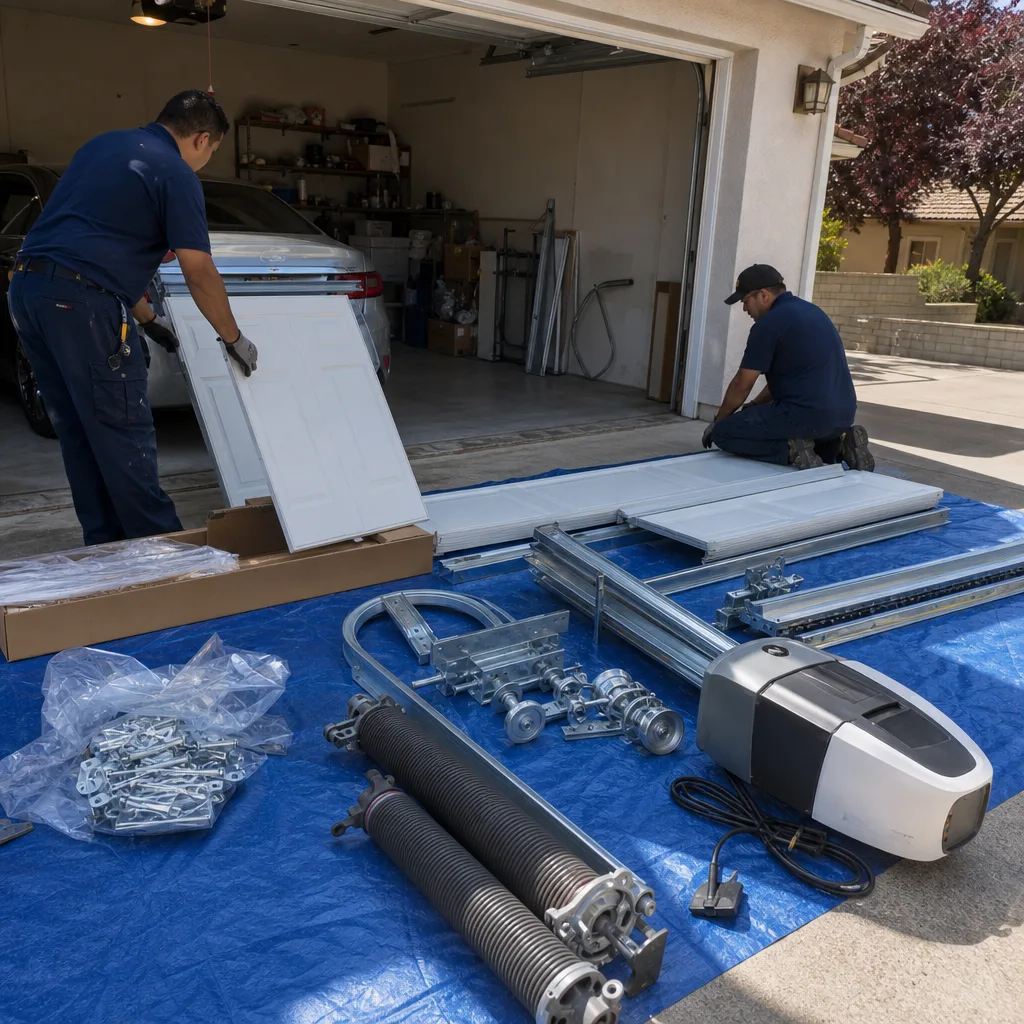
- Replacing one spring instead of two. Springs are cycled, not broken in isolation. A new spring next to a tired spring creates an imbalanced door that wrecks rollers, tracks, and hinges within months. Pair replacement is not an upsell, it’s basic mechanics.
- Lubricating the track. The rollers ride the track; they do not belong to it. Grease on the track attracts Conejo Valley dust and accelerates roller wear. The correct lubrication points are the roller bearings, hinges, and spring coils, with a silicone or lithium spray, never a heavy grease.
- Ignoring a slow-down in door travel. A door that opens more slowly than it did six months ago is telling you something. In Thousand Oaks, where summer heat thickens lubricant and winter mornings stiffen seals, a sluggish door is usually early spring fatigue or roller bearing wear. Both are cheaper to address before the component fails entirely.
- Accepting a verbal quote with no scope. In California, you have rights. In Thousand Oaks, you have options. Do not let the only documentation be a handshake. A written price and written scope before any work starts is the minimum viable standard, and it has been Clause 1 of The Haven Standard since Servo opened in 2015.
- Thinking a noisy opener means a new opener. The sound is usually telling you which specific part is dying. A grinding sound is typically a stripped drive gear or a failing trolley carriage, both component repairs under $200. A humming sound with no movement is usually the logic board or a seized capacitor. None of these require a full opener replacement unless the unit is past its service life.
- Deferring a Free Second Opinion because it feels awkward. If you have a written estimate from another Thousand Oaks garage door company, bring it. A second set of eyes on the actual paperwork can confirm the scope or show you where it’s padded. The offer is standing and does not require a coupon.
When to Call a Professional
A garage door professional should be called when the failure involves any component under tension or any system that lifts weight overhead. Torsion springs store enough energy to cause serious injury if they let go during a DIY repair. Cables under load can snap and move unpredictably. A door that has come off its track is a multi-hundred-pound object hanging on one compromised rail. None of these are beginner repairs, and the safest move in every case is to stop using the door, secure it closed if possible, and call someone who does this daily. For a door repair in Thousand Oaks, our team is available 24/7 by phone. If the door is stuck open and the garage is exposed, treat it as an emergency. We’re at Garage Door Repair in Thousand Oaks with a live person on the line whenever you call.
Servo Garage Doors Thousand Oaks offers free estimates throughout Thousand Oaks, Westlake Village, and Newbury Park. Call (424) 395-3203 and you’ll get a named technician, a written price, and a photo record of the work. No urgency, no pressure, just the documentation.
Frequently Asked Questions
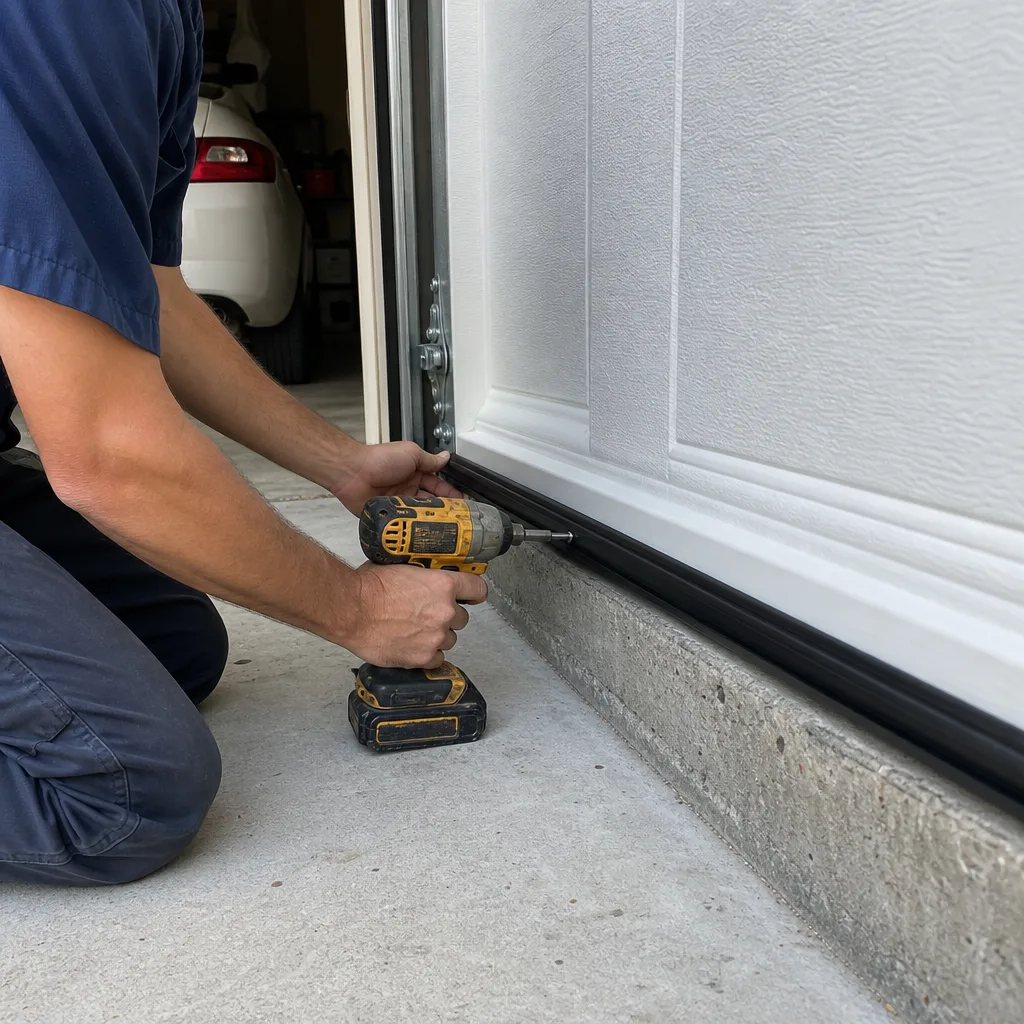
A pair of torsion springs in Thousand Oaks typically costs $280 to $450 installed, including the written estimate and the photo documentation of the failed spring. Springs are always replaced in pairs because both springs cycle the same number of times. Using a single spring replacement saves $100 to $150 up front but creates an imbalanced door that will wear out rollers and tracks within a year. The exact price depends on spring wire diameter and cycle rating, but the number is on paper before any work starts. Call (424) 395-3203 for a free estimate at your door.
Repair is usually the right call if the door is under eight years old and the damage is limited to one panel or one mechanical component. Replacement makes sense when two or more panels are damaged, the spring cycle count is second-generation, or the door’s function no longer matches the household. In Thousand Oaks, most doors are younger than their owners assume, and most replacement recommendations overstate structural damage that a photo would contradict. Run the decision tree with evidence in hand, not with a sales script.
No permit is required in Ventura County for replacing a garage door within the existing opening, or for repairing springs, cables, rollers, or openers. A permit is required only when the opening itself is being altered, which becomes a framing job. Some Thousand Oaks HOAs, particularly in Westlake, North Ranch, and Dos Vientos, require architectural review before a door style or color is changed. Check the HOA before ordering, not after.
When the opener motor runs but the door stays put, the failure is almost always in the drive system or the disconnect mechanism. The most common causes are a stripped drive gear inside the opener head, a failed trolley carriage that no longer grips the drive rail, or a pull cord that has been left in the manual release position, disengaging the door from the rail entirely. All three are diagnosable by photo and all three are component repairs, not full opener replacements. For a same-day diagnosis in Thousand Oaks, call (424) 395-3203.
The best opener for Thousand Oaks conditions is a belt-drive unit from LiftMaster or Chamberlain, with a logic board protected by a surge suppressor. Belt drives run quieter than chain drives, a real consideration when the garage sits under or next to a bedroom, and the surge protection addresses the power-spike pattern we see in neighborhoods with above-ground utility service. Expect to pay $450 to $700 installed. If you want a second set of eyes on a Garage Door Opener Repair & Installation in Thousand Oaks quote, bring the paperwork and we’ll review it against the actual scope.
A standard sectional door installation in Thousand Oaks takes one day, typically four to six hours on site. That includes removal of the old door, installation of the new door and hardware, opener integration, balance testing, and the documented photo record of the finished work. Custom doors, high-lift track conversions, or HOA-required changes to the door style may extend the process by a week or more for ordering and review. The installation itself remains a single day. Ask for a written timeline before any work is scheduled. Learn more about the process at Garage Door Installation in Thousand Oaks.
The Bottom Line
Your garage door is a six-component system, and the three components most likely to fail in Thousand Oaks within a decade are the torsion springs, the rollers, and the opener’s logic board. Conejo Valley’s dry heat and morning marine layer accelerate rubber seal failure and spring coating degradation while sparing the steel panels. Every repair should come with a photograph, a written scope, and a flat price, in dollars, before any work begins. That standard exists in writing as The Haven Standard, and it’s applied to every job we do at Servo Garage Doors Thousand Oaks home base. If the door is making noise, moving slowly, or stuck open, the cheapest decision is usually the earliest call. The documentation tells the rest of the story.
Written by Marcus Deller, Owner at Servo Garage Doors Thousand Oaks, serving Thousand Oaks since 2015.